
1 - 4 of 4 Posts

francescool

Active member
This image is amazing....I always knew that languages came from each other but I never had it visualized. Kudos to the amazing designer who made this image! As we all know, the Greek language provided the basis for many alphabets and languages around the world. Nonetheless, Greece is unlike any language that exists today and it not based on any other languages like Romance Languages for example (Spanish, Italian, etc.). If anyone has other language resources, please feel free to share with me :)

 
This image is amazing....I always knew that languages came from each other but I never had it visualized. Kudos to the amazing designer who made this image! As we all know, the Greek language provided the basis for many alphabets and languages around the world. Nonetheless, Greece is unlike any language that exists today and it not based on any other languages like Romance Languages for example (Spanish, Italian, etc.). If anyone has other language resources, please feel free to share with me :)
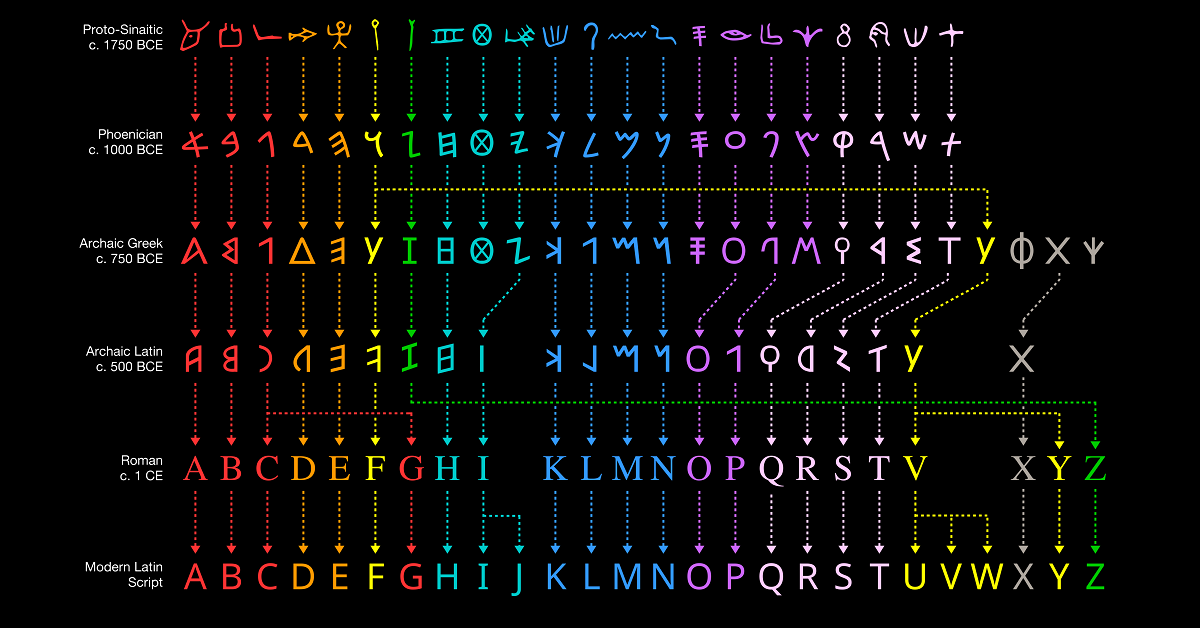
.
I liked your post and the idea of visualizing............,but, ,as you know, there is a great difference between the evolution of languages and the evolution of the alphabets of languages. I myself have done some work on the generation of Indo-European languages, but unfortunately a visualization chart [necessarily by means of alphabetical writing] would not assist the reader; like an etymologist, he must re-enact the spoken languages. [I haven't found yet a suitable publisher for my manuscript of etymologies, :INDO-EUROPEAN AND ITS SPEAKERS , sub-titled: Indo-European is Greek.]
 
I liked your post and the idea of visualizing............,but, ,as you know, there is a great difference between the evolution of languages and the evolution of the alphabets of languages. I myself have done some work on the generation of Indo-European languages, but unfortunately a visualization chart [necessarily by means of alphabetical writing] would not assist the reader; like an etymologist, he must re-enact the spoken languages. [I haven't found yet a suitable publisher for my manuscript of etymologies, :INDO-EUROPEAN AND ITS SPEAKERS , sub-titled: Indo-European is Greek.]
Ahhhh, I see. It defintley looks more simple than it actually is in this chart
 
This is an interesting resource for sure! I don't believe the Phoenician language is actually in the same language family as Greek and Latin. The article did a great job helping us visualize the alphabet similarities. But, the story is a bit more complicated than that.

As one user said, language evolution and alphabet evolution are two different things entirely. Phoenician language isn't part of the same language family as Greek (in fact, I think they both sit on different language branches entirely). But, I think it is interesting the influence the Phoenicians had in terms of alphabet evolution.
 

Why do Greeks celebrate name days?

I grew up with name days being a big deal, and I’ve always wondered why they feel more important than birthdays for so many of us. I know they’re tied to the Greek Orthodox Church feast days and the saints we’re named after, but it feels like there’s something deeper going on culturally.

In my family, name days were always open-house style, people calling, stopping by, bringing sweets, and it felt very communal. Birthdays, on the other hand, were more low-key.

Do you feel like name days still carry that same weight today? Or has it changed depending on the generation or where you live?

Are most Greeks left or right?

Are most Greeks liberal leftist progressives? Most that I encounter are. Not only that but self hating. WHY?

Greek Easter Celebrations in Greece?

I’ve been thinking a lot about Greek Easter lately and realized I don’t actually know what it’s like to experience it in Greece itself.

I grew up with the traditions here, like church services, red eggs, the midnight “Christos Anesti,” and of course the big Sunday feast, but I’m curious how it all feels in Greece. Is the atmosphere different? More intense? More communal?

What are the days leading up to Easter like there, especially Holy Week? Are there specific customs, processions, or local traditions that stand out depending on the region?

I’ve also heard things about candles at midnight, fireworks, and entire towns participating, how true is that?

Would love to hear from anyone who has experienced it in Greece or grew up there. What are the moments that really define Greek Easter for you?

Does your family make fanouropita for Saint Phanourios Day?

I recently saw a news article about Saint Fanourios Day, and it showed people bringing fanouropita cakes to a church to be blessed. I knew about fanouropita and the tradition of making it when you’re hoping to find something that has been lost, but I didn’t realize how much of a church tradition it could be on the saint’s feast day itself.

Does your family make fanouropita for Saint Fanourios Day? If so, do you bring the cake to church to be blessed, or do you usually make it at home and share it with family and friends?

I’m also curious whether this is something that is still widely done in Greece or if it depends on the region, parish, or family. Are there any other traditions your family follows for Saint Fanourios Day?

I’d love to hear how people observe the day and whether fanouropita is part of your family’s tradition.

How did your family spend summers in Greece?

I’m curious how many of you spent summers in Greece growing up.

My experience was a little different. My parents both worked full time, so we never packed up and spent entire summers in Greece the way some Greek families did. But I had friends and cousins who seemed to disappear every June and come back just before school started, full of stories about village life, island beaches, family gatherings, and adventures with cousins.

I always found those stories fascinating and sometimes wished I had experienced that myself.

For those of you who did spend summers in Greece, what was it like? Did you stay in a village, a city, or on an island? What did your typical days look like? Are there any traditions, memories, or experiences that still stand out to you today? I'd love to hear your stories!
Share and discuss Greek traditions related to Greek weddings, christenings, dance & holidays!

WorldwideGreeks.com is a free online forum community where people can discuss Greek food, travel, traditions, history and mythology.
Join Worldwide Greeks here!

JOIN COMMUNITY FOR FREE

LOGIN TO YOUR ACCOUNT
Back
Top

