1 - 2 of 2 Posts

mastichas09

Active member
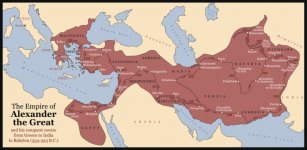
Does anyone know what made his empire so successful?

empire-alexander-the-great-900x441.jpg
 
Here are a couple of reasons off the top of my head:

- Leadership skills
- Great commander
- Very capable and experienced army
- Loyal and experienced generals
- Superior army formation and weapons (sarissa)
- Persian empire was in decline
 

ancient Greek circumflex: tilde vs. inverted breve

Apparently (https://en.wikipedia.org/wiki/Greek_diacritics) tilde and inverted breve are equivalent circumflex diacritics, but I have never come across the tilde in online ancient Greek texts. I would like to be able to type the inverted breve. The excellent program https://typegreek.com/ apparently does not allow this. Is there another program or procedure form doing this? Thanks in advance.

Transition from myth to recorded history in Greece?

I’ve been thinking about the transition from myth to recorded history in Greece, and where that shift really begins.

So much of what we associate with early Greek history comes to us through myth, stories of gods, heroes, and epic events that clearly weren’t meant as factual records, yet still carry cultural and historical weight. At some point, though, we start seeing attempts to document events, places, and people in a more deliberate way.

I’m curious how others understand this transition. Do you see myth and history as clearly separate phases, or more as overlapping ways of explaining the world? Figures like Homer, Hesiod, and later historians seem to sit somewhere in between storytelling and record-keeping.

What do you think prompted the move toward written history? Was it political organization, trade, literacy, or something else entirely? And how much of myth do you think still shaped the way early historians understood and recorded their past?

Fall of the City States (Polis)

I’ve been reading more about ancient Greek history lately, and something struck me — we always hear about the rise of the polis and how important city-states like Athens and Sparta were, but I don’t see as much discussion about how that system actually declined.

What led to the fall of the polis as the dominant structure in Greek life? Was it mainly due to constant warfare like the Peloponnesian War, or did larger powers like Macedon gradually make the independent city-state model obsolete?

I’m especially curious about whether this was a sudden shift or more of a slow transition over time. Did people living through it even realize the polis era was ending?

I’d love to gather more insight on this. Greek history is a big interest of mine, and this feels like an important piece I haven’t fully understood yet.

Greek life under Roman rule?

I’ve been reading more about Greek history lately, especially periods that don’t get as much everyday attention, and I keep coming back to Greek life under Roman Empire rule.

I know the broad timeline, Greece absorbed into the Roman world, cities continuing to function, Greek culture influencing Rome as much as the other way around — but I’m really curious about the lived experience. What did daily life actually feel like for ordinary Greeks during this period? How much continuity was there with earlier Hellenistic life, and where did Roman administration, law, or customs really change things?

I love history most when I can picture it: streets, homes, education, food, language, religion. Were people aware they were living in a “Roman” era, or did it feel like Greek life with a new layer on top?

If anyone has thoughts, favorite books, articles, documentaries, or even museum resources, I’d love recommendations.

What was life like under Roman Greece?

I’ve been going down a bit of a Greek history rabbit hole lately, and I realized I don’t know much about what everyday life was like when Greece was under Roman rule.

We always hear so much about classical Greece and then later Byzantine history, but that Roman period feels a little less talked about, at least in detail.

I’m curious how much actually changed for people living there at the time. Did daily life feel very different from earlier Greek periods, or did a lot of traditions and culture continue as usual? And how did Greeks view Roman authority, was it accepted, resisted, or somewhere in between?

If anyone has insights, favorite sources, or even small details about daily life, I’d love to hear them.
Share and discuss Greek history!

WorldwideGreeks.com is a free online forum community where people can discuss Greek food, travel, traditions, history and mythology.
Join Worldwide Greeks here!

JOIN COMMUNITY FOR FREE

LOGIN TO YOUR ACCOUNT
Back
Top

