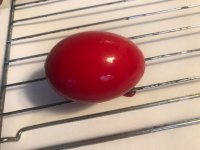
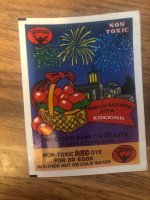
Traditionally Greeks dye their red eggs on the Thursday of Holy Week. Greeks are really into tradition. I'm wondering what other people have come up with as being easiest. It has taken years of analyzing the way that works best for me, so I thought I'd share.... So, when I was a kid my mother used Ritz red dye, and we used to EAT the eggs. It's a miracle we didn't get poisoned. Then I decided to use red food coloring and eggs came out pink, not the rich red symbolic of the blood of Christ. Then I discovered that the Greek store (I go to Sophia's in Lowell, MA) sells dye specific for dying eggs with directions in both English and Greek on the back. So I followed the directions on the back and dumped the whole packet into a huge pan which ended up hard to clean. As time went on, I discovered I could use only ½ of the packet and use a small container, doing 4 eggs at a time. This year I only used ⅓ of the contents of the packet. So what do you do?

Menu
Install the app
How to install the app on iOS
Follow along with the video below to see how to install our site as a web app on your home screen.
Note: This feature may not be available in some browsers.
You are using an out of date browser. It may not display this or other websites correctly.
You should upgrade or use an alternative browser.
You should upgrade or use an alternative browser.
1 - 7 of 7 Posts




Thiraform massage Santori
New member
Traditionally you can use red and white onion leaves to color red eggs and tumeric to color yellow eggs.They result in pretty good.(ofcourse not as bright as chemical coloring)
Oh wow. Bet that's what Greeks in Greece do. They figured out how to do everything from what they have in nature. Our ancestors were unbelievable!Traditionally you can use red and white onion leaves to color red eggs and tumeric to color yellow eggs.They result in pretty good.(ofcourse not as bright as chemical coloring)
My mother used the same red dye. I don't think you can get that deep red color with anything else. Sometimes the dye would seep into the egg, but we just cut it off. I'm smiling because I remember one Easter when my brother realized what she used. He had a hissy fit! I said to him, "You've been eating these eggs for over 50 years and you're still fine." His response "Who says I'm fine?!" After the eggs were cooled, she would take a soft clean cloth with a little olive oil on it and "polish" the eggs. They looked so beatiful - so red and shiny.
Happy Easter to all from the Boston area! (Though I have been vaccinated, I'm still pretty much in lockdown.
Happy Easter to all from the Boston area! (Though I have been vaccinated, I'm still pretty much in lockdown.
What do you use now to dye your eggs?My mother used the same red dye. I don't think you can get that deep red color with anything else. Sometimes the dye would seep into the egg, but we just cut it off. I'm smiling because I remember one Easter when my brother realized what she used. He had a hissy fit! I said to him, "You've been eating these eggs for over 50 years and you're still fine." His response "Who says I'm fine?!" After the eggs were cooled, she would take a soft clean cloth with a little olive oil on it and "polish" the eggs. They looked so beatiful - so red and shiny.
Happy Easter to all from the Boston area! (Though I have been vaccinated, I'm still pretty much in lockdown.

Patisqua
Member
My dying red eggs for Easter is over. When my sister and I retired we de-cluttered our house. The saucepan i made the red eggs in was given away. Ii only used that saucepan for red eggs.i now go to our local Greek cake shop and order them. I still make sort of koulourakia - I just cannot roll them, melamoukarona without syropi, kouranbries without additional icing sugar. Please do not think other Australian-Greeks do that. I have a blended family and I would rather they eat what they enjoy.
efhernandez_
Active member
I didn't know you could order eggs! That's a cool idea i'll have to try it outMy dying red eggs for Easter is over. When my sister and I retired we de-cluttered our house. The saucepan i made the red eggs in was given away. Ii only used that saucepan for red eggs.i now go to our local Greek cake shop and order them. I still make sort of koulourakia - I just cannot roll them, melamoukarona without syropi, kouranbries without additional icing sugar. Please do not think other Australian-Greeks do that. I have a blended family and I would rather they eat what they enjoy.
1 - 7 of 7 Posts
JOIN THE DISCUSSION AND READ OTHER GREEK INFO:
Does your family make fanouropita for Saint Phanourios Day?
- mastichas09
- Greek Traditions Forum
- Replies: 1
I recently saw a news article about Saint Fanourios Day, and it showed people bringing fanouropita cakes to a church to be blessed. I knew about fanouropita and the tradition of making it when you’re hoping to find something that has been lost, but I didn’t realize how much of a church tradition it could be on the saint’s feast day itself.
Does your family make fanouropita for Saint Fanourios Day? If so, do you bring the cake to church to be blessed, or do you usually make it at home and share it with family and friends?
I’m also curious whether this is something that is still widely done in Greece or if it depends on the region, parish, or family. Are there any other traditions your family follows for Saint Fanourios Day?
I’d love to hear how people observe the day and whether fanouropita is part of your family’s tradition.
How did your family spend summers in Greece?
- xmelissaa
- Greek Traditions Forum
- Replies: 2
I’m curious how many of you spent summers in Greece growing up.
My experience was a little different. My parents both worked full time, so we never packed up and spent entire summers in Greece the way some Greek families did. But I had friends and cousins who seemed to disappear every June and come back just before school started, full of stories about village life, island beaches, family gatherings, and adventures with cousins.
I always found those stories fascinating and sometimes wished I had experienced that myself.
For those of you who did spend summers in Greece, what was it like? Did you stay in a village, a city, or on an island? What did your typical days look like? Are there any traditions, memories, or experiences that still stand out to you today? I'd love to hear your stories!
Information About Apokries?
- kcixcy
- Greek Traditions Forum
- Replies: 1
I’ve been curious about how people experience Apokries and what it looks like in different parts of Greece. For some, it seems centered on big public celebrations and costumes, while for others it’s more about smaller gatherings, food, and local customs.
I’m especially interested in the traditions people grew up with. Was Apokries something your family actively celebrated, or did it feel more like a community event? Did you attend costume parties, parades, or specific local festivities? And how did days like Tsiknopempti fit into it for you?
I’d also love to hear whether your experience changed over time, for example, celebrating differently as a child versus as an adult, or noticing differences between village and city celebrations.
For those who no longer live in Greece, do you still mark Apokries in some way, or has it faded with distance?
I’m looking forward to hearing how this tradition shows up for others.
Why do Greeks celebrate name days?
- auroracoor1
- Greek Traditions Forum
- Replies: 1
I grew up with name days being a big deal, and I’ve always wondered why they feel more important than birthdays for so many of us. I know they’re tied to the Greek Orthodox Church feast days and the saints we’re named after, but it feels like there’s something deeper going on culturally.
In my family, name days were always open-house style, people calling, stopping by, bringing sweets, and it felt very communal. Birthdays, on the other hand, were more low-key.
Do you feel like name days still carry that same weight today? Or has it changed depending on the generation or where you live?
What are your favorite name day traditions?
- paharo45
- Greek Traditions Forum
- Replies: 1
I’ve always loved the tradition of celebrating name days. In my family, they’re just as meaningful as birthdays, and sometimes even more fun because they bring everyone together in a different way.
When a big name day comes around, especially one that several family members share, we often turn it into a full family gathering. For example, on a name day like Nick/Nikolas, where there might be multiple people celebrating, it becomes almost like a mini family holiday. Someone hosts, there’s plenty of food, and everyone comes by to wish the celebrants “chronia polla.”
I also like the simplicity of the tradition. Even if there isn’t a big gathering, people still call or send messages to acknowledge the day.
Do you celebrate name days in your family? And are there certain ones that turn into larger celebrations because several people share the name?
Share and discuss Greek traditions related to Greek weddings, christenings, dance & holidays!
WorldwideGreeks.com is a free online forum community where people can discuss Greek food, travel, traditions, history and mythology.
Join Worldwide Greeks here!
Join Worldwide Greeks here!
JOIN COMMUNITY FOR FREE
LOGIN TO YOUR ACCOUNT

