1 - 7 of 7 Posts

Hash

Well-known member
The statues of Cleopatra and her husband Dioscurides were placed by the entrance of their house to greet the guests. Delos island, Cyclades, Greece. https://t.co/t2gzPx0K9yScreenshot_2022-01-13-16-06-02-623_com.twitter.android.jpg
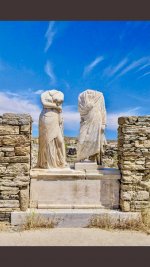
 
I have been intrigued by Delos for some time - seems like there are a lot of great artifacts there. I didn't realize Cleopatra and her husband were depicted here!
 
  • Like
Reactions: Hash and seleanor
I have been intrigued by Delos for some time - seems like there are a lot of great artifacts there. I didn't realize Cleopatra and her husband were depicted here!
Me neither! I love Kleopatra!!
 
  • Like
Reactions: Hash
Me neither! I love Kleopatra!!
When I was working promoting Delos Excursions we asked my Tour Guides to recreate a model village of what Delos would have looked like it's original days....A Majestic and powerful force to reckon with....All the Tour Guides received standing ovations and .... lots of tips.... rightfully deserved....The poor Tour Guides working every day in unbearable heat and sometimes 5/6 Guided Tours per day... Respect and Salute for them♥️♥️...I remember them all well.My sentimental and meaningful contribution to the Greek Tourism Industry.
 
  • Like
Reactions: greekgal77
When I was working promoting Delos Excursions we asked my Tour Guides to recreate a model village of what Delos would have looked like it's original days....A Majestic and powerful force to reckon with....All the Tour Guides received standing ovations and .... lots of tips.... rightfully deserved....The poor Tour Guides working every day in unbearable heat and sometimes 5/6 Guided Tours per day... Respect and Salute for them♥️♥️...I remember them all well.My sentimental and meaningful contribution to the Greek Tourism Industry.
It would have been amazing seeing a tour like that!!! I was looking at some photos and Delos looks so interesting.
 
  • Like
Reactions: Hash
It would have been amazing seeing a tour like that!!! I was looking at some photos and Delos looks so interesting.
It is!!......The museum is now reburised and modernised, if you have an opportunity to visit,do it in April/Early May..... you will see the island full of red Poppies,Chrysanthemum and other pretty colorful flowers.... Kalley Mera from Thailand.

 
  • Like
Reactions: greek_ggirl
It is!!......The museum is now reburised and modernised, if you have an opportunity to visit,do it in April/Early May..... you will see the island full of red Poppies,Chrysanthemum and other pretty colorful flowers.... Kalley Mera from Thailand.

Stunning! I've never seen red poppies in Greece
 

Greek life under Roman rule?

I’ve been reading more about Greek history lately, especially periods that don’t get as much everyday attention, and I keep coming back to Greek life under Roman Empire rule.

I know the broad timeline, Greece absorbed into the Roman world, cities continuing to function, Greek culture influencing Rome as much as the other way around — but I’m really curious about the lived experience. What did daily life actually feel like for ordinary Greeks during this period? How much continuity was there with earlier Hellenistic life, and where did Roman administration, law, or customs really change things?

I love history most when I can picture it: streets, homes, education, food, language, religion. Were people aware they were living in a “Roman” era, or did it feel like Greek life with a new layer on top?

If anyone has thoughts, favorite books, articles, documentaries, or even museum resources, I’d love recommendations.

ancient Greek circumflex: tilde vs. inverted breve

Apparently (https://en.wikipedia.org/wiki/Greek_diacritics) tilde and inverted breve are equivalent circumflex diacritics, but I have never come across the tilde in online ancient Greek texts. I would like to be able to type the inverted breve. The excellent program https://typegreek.com/ apparently does not allow this. Is there another program or procedure form doing this? Thanks in advance.

Learning About Ancient Corinth

I’m hoping to visit the ruins of Ancient Corinth on a future trip to Greece, and I’d like to learn more about the history before I go. I always find that I appreciate archaeological sites more when I understand what I’m looking at and know some of the stories behind the ruins.

For those who have visited Ancient Corinth, what would you recommend learning about beforehand? Are there particular periods of the city’s history, important events, or historical figures that help put the site into context? I know Corinth had an important location and a long history, but I’d like to understand more about how the city developed and changed over time.

I’d also love recommendations for books, documentaries, podcasts, or other resources that give a good introduction to Ancient Corinth. What helped you understand the site and its history before or after your visit?

Analyzing Greece in World War I

I recently got into a discussion with some family members about Greece’s role in World War I, and it made me realize I don’t fully understand what happened.

From what I gather, Greece was pretty divided at the time, especially between King Constantine I and Eleftherios Venizelos, but I’m a little unclear on how that actually played out in terms of alliances and decisions.

Was Greece officially neutral at first? And how did it eventually end up joining the war on the Allied side?

I’ve also heard the term “National Schism” come up in this context—how significant was that in shaping Greece’s involvement?

If anyone has a clear way of explaining this period, or can point out the key events to focus on, I’d really appreciate it. It feels like an important piece of history I should understand better.

Fall of the City States (Polis)

I’ve been reading more about ancient Greek history lately, and something struck me — we always hear about the rise of the polis and how important city-states like Athens and Sparta were, but I don’t see as much discussion about how that system actually declined.

What led to the fall of the polis as the dominant structure in Greek life? Was it mainly due to constant warfare like the Peloponnesian War, or did larger powers like Macedon gradually make the independent city-state model obsolete?

I’m especially curious about whether this was a sudden shift or more of a slow transition over time. Did people living through it even realize the polis era was ending?

I’d love to gather more insight on this. Greek history is a big interest of mine, and this feels like an important piece I haven’t fully understood yet.
Share and discuss Greek history!

WorldwideGreeks.com is a free online forum community where people can discuss Greek food, travel, traditions, history and mythology.
Join Worldwide Greeks here!

JOIN COMMUNITY FOR FREE

LOGIN TO YOUR ACCOUNT
Back
Top
