
1 - 4 of 4 Posts

blopez34

Active member
The Hecatoncheires or “hundred-handed one” in Greek, are a group of four mythological giants in Ancient Greek mythology. Sometimes they're also called Centimanes. Aegeon is really related to them because his connection with the sea has been drawn by numerous scholars contemporary of Ancient Greece, including Homer. Virgil and Ovid describe Aegeon being not an ally of Zeus, but rather a traitor of his brother and an enemy of the gods, who fought alongside Cronus in the Titanomachy.
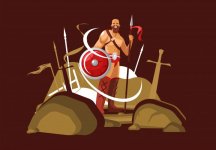


titanomachy-zeus-720x501.jpeg
 
I had no idea, this story is a little niche for my level of Greek mythology knowledge LOL
 
I had no idea, this story is a little niche for my level of Greek mythology knowledge LOL
It's amazing how many characters and creatures there are in Greek Mythology. It's fascinating to learn about, but it can be hard keeping everyone straight.

Thank you, blopez34, for sharing about them!
 
Please note Aegaeon is a name for the constellation Capricorn [ Aegoceros in Greek].When Capricorn [Pan/Min] rises Cancer[Hera/Scylla/Skyllaros/hermit-crab] and Gemini[Poseidon/Castor/Set and Hades/Pollux/Osiris] fade. Note the myths of Hyas/Aquarius [Polymelus] and Leo, and Scorpio killing Orion. There are numerous other examples in Greek myth. Minos/Pan Phorbas said to have killed Scylla/Megara
[Megaera/Erinys/Fury/Selene/Arsinoe].
See lunacy/mania for madness inflicted by Luna/
Mene/Selene.
Aegaeon[ Cronus] defeated Hera, Hades and Poseidon for Zeus. Aegaeon also called Briareus [Norse Freyr ].
Cronus and Aphrodite [Freyja/Inanna/Nanna] were the children of Uranus [ Anu ]. Min is called Pan or Priapus [ Prajapati in India ] by the Greeks.
Odin is Uranus [ Arion/Pegasus/Harun/Chiron/Charun ], Freyr is Cronus and Thor is Zeus.
Norse Thjazi/Thiassi [Tityus ] is Aeetes. Skadi is Medea. Njord is Ninurta [Nimrod], i.e. Freyr [ Jason]. Lycus is Wayland [Freyr /Egyptian Wepwawet/ Fenrir]. Wayland/Volundr is Alexander/Paris.
Wepwawet [ Cain ] was god of Ursa Minor/Polaris/Polus [ Upelluri/ Atlas ].
Athena Aphaea [Penelope] was Hecate and Chiron ['hand'] is Hermes, parents of Pan/Aegaeon [Hecatoncheire].
Athene was called Idun/Ithunn in Scandinavia and Eithne in Ireland.
Henioche [Hera/Ma/Maia/Selene/Hebat/Hebe/
Nephthys/NebtHet/'Lady of the Temple'/Hiera/priestess/St Non/Nun/
Eurydice ] was the mother of Sinis [Sin/Pityocamptes/Pittheus/Men/Moon-god to whom the bucranium/ox-skull/Taurus and pinecone were sacred]. Perigune [ Rhea Pitys], the daughter of Sinis, married Deioneus
[Dian Cecht/Dagon/Pan/Min/Cronus]. Ixion [Set/Poseidon] supposedly slew Deioneus. Deioneus was the father of Dia
[Hebe/Ganymeda].
Henioche [Megara/Eurydice] was the daughter of Creon [Irish Grian/Grannus/Lug].
The osprey [sea-eagle/Pandion Haliaetus]
was linked to the constellation Aquila.
Boreas [Aquilo] is Pandion [Danaus]. Butes [Ares/
Creon/Nisus/Ninshubur/Samson/Shamash] was the son of Pandion/Boreas.
Dhanus meaning bow is a name for Saggitarius.
 
Last edited:

Unsung Heroes of Greek Mythology?

Greek mythology is full of larger-than-life figures like Heracles, Odysseus, and Achilles, but I’ve always been fascinated by the lesser-known heroes who don’t get as much attention. There are so many incredible stories that fly under the radar: Meleager and the Calydonian Boar, Bellerophon taming Pegasus, or even Diomedes, who faced the gods themselves in battle.

I recently came across the story of Atalanta again, the only woman among the Argonauts, raised by a bear, unbeatable in a footrace, and I can’t believe she isn’t talked about more! These “side characters” often feel more human and relatable than the famous ones.

Which lesser-known hero (or heroine) stands out to you? Do you have a favorite overlooked myth or backstory that deserves more love? I’d love to hear which of these hidden legends captured your imagination and why.

Role of Women in Greek Myths?

Greek mythology is full of powerful stories, but lately I’ve been thinking about the role of women within those stories and I’d love to hear everyone’s interpretations.

Women in Greek myth are everywhere: goddesses, queens, witches, victims, heroes, catalysts. Yet their roles can be wildly contradictory. We have figures like Athena, symbolizing wisdom and strategic power, alongside Aphrodite, who shapes fate through desire. Then there’s Hera, often portrayed as jealous, but also deeply tied to marriage and sovereignty. Mortal women, like Penelope, Helen, Medea, or Ariadne, each carry a different kind of strength, suffering, or agency.

Some myths elevate women as creators or protectors; others reduce them to cautionary tales. And in some stories, women seem to drive the entire narrative even when the focus is supposedly on male heroes. So what do you think? What is the role of women in Greek myths?

Which Greek myth feels most relevant to modern life?

I am curious, which Greek myths feel the most relevant to you in modern life? I’ve been thinking about this lately and I’m curious how others see it.

For me, the myth that feels most relevant right now is Narcissus. The focus on reflection, self-image, and the need for validation feels very familiar in a world shaped by social media. So much of modern life revolves around how we look, how we’re perceived, and how much attention or approval we receive.

The story feels less about vanity and more about becoming absorbed in an image and losing real connection in the process. That idea seems especially timely.

What about you? Which Greek myth feels most relevant to modern life, and what makes it stand out to you today?

Learning About Cronus of Greek Mythology

I’ve been learning more about Cronus lately and realized that I only knew the most basic parts of his story. I knew he was one of the Titans and the father of Zeus, but there is much more to his role in Greek mythology.

Cronus overthrew his own father, Uranus, and later became ruler during what was sometimes described as a Golden Age. He was also warned that one of his children would eventually overthrow him, which led to the famous story of him swallowing each of them after they were born. Zeus, of course, escaped that fate and eventually defeated him.

I’m curious how others view Cronus. Do you think of him mainly as a villain, or as a more complicated figure shaped by fear and prophecy? Are there any lesser-known stories about Cronus that you think are especially interesting or important to understanding him?

Was Corfu Really Homer's Scheria?

I'm hoping to visit Corfu in late summer or early fall, so I've been reading more about the island's mythology before I go. One thing that keeps coming up is the idea that Corfu was Homer's Scheria, home of the Phaeacians in the Odyssey. The more I read, the more fascinated I become.

I know there are different theories, and not everyone agrees that Scheria was actually Corfu. Still, it's fun to imagine Odysseus washing ashore there and meeting Nausicaa before finally returning to Ithaca. It certainly adds another layer to visiting the island.

What do you all think? Do you believe Corfu really inspired Homer's Scheria, or do you think Scheria was meant to be an entirely mythical place? I'd also love recommendations for any sites on Corfu with strong connections to these myths that are worth visiting.
Share and discuss Greek mythology!

WorldwideGreeks.com is a free online forum community where people can discuss Greek food, travel, traditions, history and mythology.
Join Worldwide Greeks here!

JOIN COMMUNITY FOR FREE

LOGIN TO YOUR ACCOUNT
Back
Top
