1 - 9 of 9 Posts

acamp7

Active member
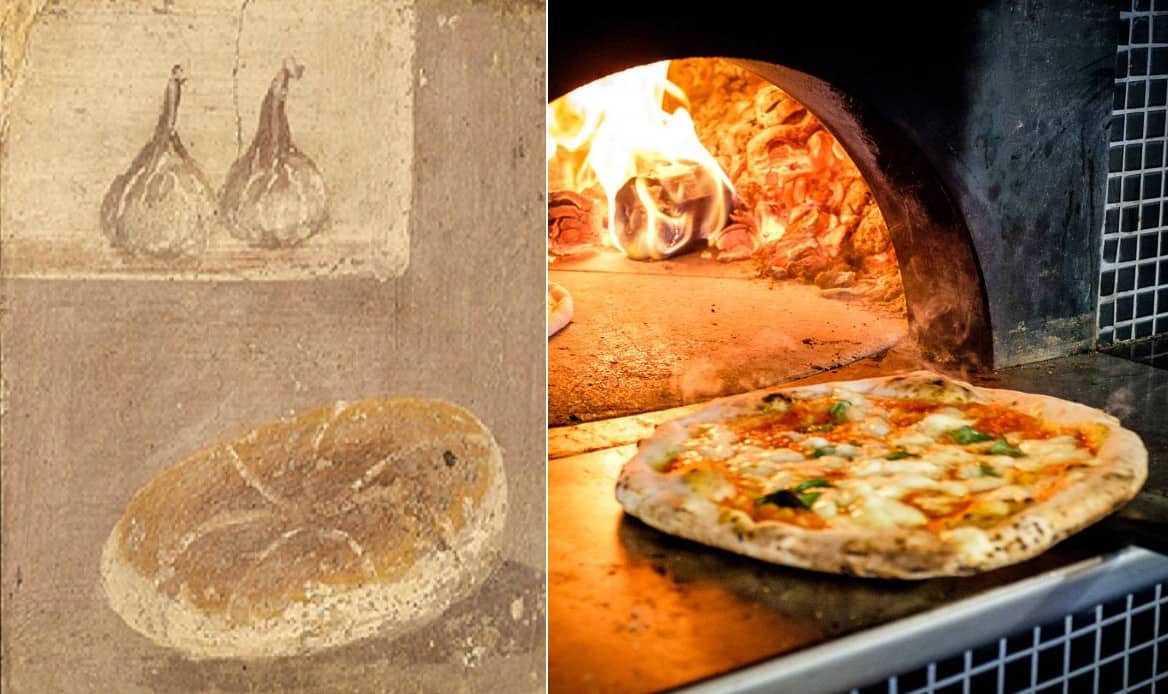
I have stumbled upon a very interesting article that proves Greeks may be the original inventors of pizza! At the end of the day, it doesn't really matter, especially since our cultures are so close and im sure that hundreds of cultures have been eating different variations of bread, tomato and cheese. Let me know if you think that Greeks actually invented pizza!!


  • Like
Reactions: The Greek Vibe
While in Santorini we visited ancient city of Acrotiri and saw the proof that the Ancient Greeks invented pizza and crepes.
 
  • Like
Reactions: blopez34
While in Santorini we visited ancient city of Acrotiri and saw the proof that the Ancient Greeks invented pizza and crepes.
What is the proof? Is there a museum? I would love to visit :)
 
Yes of course it is in the archeological museum of Santorini.
 
  • Like
Reactions: seleanor
You could say that. You can find something very similar to pizza, a traditional "pita" made and eaten on the island of Kimolos in the Cyclades. It is called "ladenia" and is made of a pizza-like dough and topped with onions, tomatoes, and olive oil.
 
  • Like
Reactions: nadellii
You could say that. You can find something very similar to pizza, a traditional "pita" made and eaten on the island of Kimolos in the Cyclades. It is called "ladenia" and is made of a pizza-like dough and topped with onions, tomatoes, and olive oil.
Is it still eaten today?
 
Is it still eaten today?
Yes it is! The bakeries on Kimolos and Milos make it and you can also find the recipe and make it yourself. Below a photo of mine.
 

Attachments

  • ladenia.jpeg
    ladenia.jpeg
    154.6 KB · Views: 0
Yes it is! The bakeries on Kimolos and Milos make it and you can also find the recipe and make it yourself. Below a photo of mine.
Wow, this looks delicious. This truly does look like it could be a pizza precursor. So yummy! One day soon I will hopefully have a chance to try his for myself.
 
  • Like
Reactions: The Greek Vibe
Wow, this looks delicious. This truly does look like it could be a pizza precursor. So yummy! One day soon I will hopefully have a chance to try his for myself.
And you'll be coming back for more!
 

Analyzing Greece in World War I

I recently got into a discussion with some family members about Greece’s role in World War I, and it made me realize I don’t fully understand what happened.

From what I gather, Greece was pretty divided at the time, especially between King Constantine I and Eleftherios Venizelos, but I’m a little unclear on how that actually played out in terms of alliances and decisions.

Was Greece officially neutral at first? And how did it eventually end up joining the war on the Allied side?

I’ve also heard the term “National Schism” come up in this context—how significant was that in shaping Greece’s involvement?

If anyone has a clear way of explaining this period, or can point out the key events to focus on, I’d really appreciate it. It feels like an important piece of history I should understand better.

Why does the Battle of Thermopylae still capture so much attention?

The Battle of Thermopylae is one of those moments in Greek history that still seems to capture people's attention thousands of years later. The story of Leonidas and the small Greek force standing against the much larger Persian army has become a symbol of courage, sacrifice, and resistance against overwhelming odds.

Of course, the real history is more complicated than the legend, and Thermopylae was only one part of the larger Greco-Persian Wars. Still, there is something powerful about the idea of people choosing to hold their ground even when they know the outcome may not be in their favor.

I also think modern books, movies, and popular culture have helped keep the story alive, sometimes blending history with mythology. Why do you think the Battle of Thermopylae still fascinates people so much? Is it the history itself, the symbolism, or the legend that grew around it?

Learning About Ancient Corinth

I’m hoping to visit the ruins of Ancient Corinth on a future trip to Greece, and I’d like to learn more about the history before I go. I always find that I appreciate archaeological sites more when I understand what I’m looking at and know some of the stories behind the ruins.

For those who have visited Ancient Corinth, what would you recommend learning about beforehand? Are there particular periods of the city’s history, important events, or historical figures that help put the site into context? I know Corinth had an important location and a long history, but I’d like to understand more about how the city developed and changed over time.

I’d also love recommendations for books, documentaries, podcasts, or other resources that give a good introduction to Ancient Corinth. What helped you understand the site and its history before or after your visit?

Most forgotten period of Greek history?

I was in Crete once eating at a restaurant and there was a pile of artifacts heaped - broken pottery shards, etc. The restaurant told us that they were going to throw them out. I said, but they are artifacts, why?! They said that no one cares about that time period the artifacts came from - something about an Arabic occupation.

I thought it was interesting and it stayed with me nearly two decades later. This is clearly a forgotten period of Greek history. Does this happen a lot in Greece? Got me thinking about Greek history and what else may be forgotten... Would love your thoughts.

Greek life under Roman rule?

I’ve been reading more about Greek history lately, especially periods that don’t get as much everyday attention, and I keep coming back to Greek life under Roman Empire rule.

I know the broad timeline, Greece absorbed into the Roman world, cities continuing to function, Greek culture influencing Rome as much as the other way around — but I’m really curious about the lived experience. What did daily life actually feel like for ordinary Greeks during this period? How much continuity was there with earlier Hellenistic life, and where did Roman administration, law, or customs really change things?

I love history most when I can picture it: streets, homes, education, food, language, religion. Were people aware they were living in a “Roman” era, or did it feel like Greek life with a new layer on top?

If anyone has thoughts, favorite books, articles, documentaries, or even museum resources, I’d love recommendations.
Share and discuss Greek history!

WorldwideGreeks.com is a free online forum community where people can discuss Greek food, travel, traditions, history and mythology.
Join Worldwide Greeks here!

JOIN COMMUNITY FOR FREE

LOGIN TO YOUR ACCOUNT
Back
Top