
Menu
Install the app
How to install the app on iOS
Follow along with the video below to see how to install our site as a web app on your home screen.
Note: This feature may not be available in some browsers.
You are using an out of date browser. It may not display this or other websites correctly.
You should upgrade or use an alternative browser.
You should upgrade or use an alternative browser.
Greek Mythology Community
Prove the mythological gods do not exist
- Thread starter amygdalE
- Start date
1 - 12 of 12 Posts
I can't weigh in either way but I have been studying mythology lately and what has been on my mind is - the people who brought these stories to life (the Ancient Greeks) believed that the gods and goddesses exist. So... it has changed my perspective while reading about them!
Raymond Gorgone
New member
If you are interested in learning about an alternative perspective on the gods, visit geographicalimagesofthegods.org. There I show how the ancients interpreted geographical imagery to create gods and myths.
If you are interested in learning about an alternative perspective on the gods, visit geographicalimagesofthegods.org. There I show how the ancients interpreted geographical imagery to create gods and myths.
I have already replied...... Sorry again; your perspective does not prove or disprove the existence of gods,
The question whether they exist or not is a philosophical question , which applies a fortiori [all the more] to the belief in one GOD, whether it is called ZEUS or simply THEOS. Update: Theodosius banished polytheism and, unwittingly, any theism. The Christian iconoclasts did the same. Why should we be concerned at all? [Sorry, if I am going beyond the bounderies of THIS mythology forum.]or that they exist
they believed in deities for some reasons! they, i think, were not irrational believers.... i asked these questions to hear from contemporary Greek philosophers/thinkers -- you and you [reader]I can't weigh in either way but I have been studying mythology lately and what has been on my mind is - the people who brought these stories to life (the Ancient Greeks) believed that the gods and goddesses exist. So... it has changed my perspective while reading about them!
Last edited:
Recently I learned that some modern Greeks tried to revive some ancient Gr. religion, e.g., the 2005 ELLINAIS [q.vide in WIKIPEDIA]. Maybe some of you know more about it: Do the members actually believe in some ancient gods, or are they lovers and commemorators of Hellenismos? // I love my recent internet discovery, the ruins of the temple of the Olympian Zeus in Athens.

dpappas87
Active member
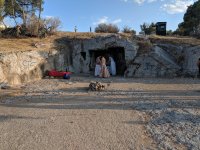
Wow, that must have been a fascinating moment to witness!I bet you these people can answer your questions. They look like they are setting up for an ancient ceremony. This was snapped on Filopapou hill on a full moon day.
View attachment 1168
The fact of belief does not imply that they exist and, as far as I know, nobody has ever constructed proofs. Timaeus, Aristotle, et al,I can't weigh in either way but I have been studying mythology lately and what has been on my mind is - the people who brought these stories to life (the Ancient Greeks) believed that the gods and goddesses exist. So... it has changed my perspective while reading about them!
Belief is not proof..... Timaeus, Aristotle, et al., argued for some supreme god, unrelated to any ethnic god, for an abstract monotheism. THIS went well with Christian monotheism, which arose from blundering translators of the Hebrew Bible: Genesis-1 posits, as in the Cananite Ugarit, the ELOHIM [= GODS] , who decided to produce Man in their own image -- one male and one female; whereas Genesis-2 posits one male god, YAHWEH, who produced ADAM out of clay and breathed life into it. The translators used THEOS for both the Elohim and Yahveh -- a linguistic monism.I can't weigh in either way but I have been studying mythology lately and what has been on my mind is - the people who brought these stories to life (the Ancient Greeks) believed that the gods and goddesses exist. So... it has changed my perspective while reading about them!
1

Vangelis
Active member
I was lucky enough one year to have my room upgraded at the Royal Olympic Hotel to a massive room with a view to the temple of Olympian Zeus. Every morning I would wake up and open my curtain to this view (also, small tip, go to google maps and hover your cursor over the icon of the temple of Zeus to see a 360 view):I love my recent internet discovery, the ruins of the temple of the Olympian Zeus in Athens.

Raymond Gorgone
New member
While it may be impossible to prove the gods have never existed, if geographicalimagesofthegods.org demonstrates that many myths concerning the gods are based on the interpretation of geographical imagery, what might that tell us about the gods?
1 - 12 of 12 Posts
JOIN THE DISCUSSION AND READ OTHER GREEK INFO:
Unsung Heroes of Greek Mythology?
- ssherie_
- Greek Mythology Forum
- Replies: 1
Greek mythology is full of larger-than-life figures like Heracles, Odysseus, and Achilles, but I’ve always been fascinated by the lesser-known heroes who don’t get as much attention. There are so many incredible stories that fly under the radar: Meleager and the Calydonian Boar, Bellerophon taming Pegasus, or even Diomedes, who faced the gods themselves in battle.
I recently came across the story of Atalanta again, the only woman among the Argonauts, raised by a bear, unbeatable in a footrace, and I can’t believe she isn’t talked about more! These “side characters” often feel more human and relatable than the famous ones.
Which lesser-known hero (or heroine) stands out to you? Do you have a favorite overlooked myth or backstory that deserves more love? I’d love to hear which of these hidden legends captured your imagination and why.
Favorite Greek hero and why?
- kcixcy
- Greek Mythology Forum
- Replies: 1
I’ve been spending more time lately reading Greek mythology, and I keep coming back to how different the heroes are from one another. Some rely on strength, others on intelligence, and some seem almost defined by their flaws as much as their accomplishments. It makes the stories feel more human than I expected.
Personally, I find characters like Odysseus interesting because of the strategy and endurance involved, but I can also see the appeal of someone like Heracles with the raw physical trials. Achilles is another one who’s hard to ignore because of the intensity and tragedy built into his story.
I’m curious which Greek hero stands out most to others and what draws you to them. Is it their personality, their achievements, or the story itself?
Who were the Greek Fates?
- acamp7
- Greek Mythology Forum
- Replies: 1
I've been spending a lot of time reading about Greek mythology lately, and one group of figures I keep coming across are the Greek Fates. The more I read, the more fascinating they seem. From what I understand, they were responsible for determining the course of every person's life, but I'd love to learn more from people who have studied the myths in greater depth.
How were the Fates viewed by the ancient Greeks? Were even the Olympian gods subject to their decisions, or did Zeus have authority over them? I've seen different interpretations depending on the source.
I'm also curious if there are any myths where the Fates play a particularly important role that you'd recommend reading. Greek mythology is such a deep subject, and I'm always looking for new stories and perspectives to explore. I'd love to hear your thoughts and recommendations!
What is the symbolism behind Medusa?
- auroracoor1
- Greek Mythology Forum
- Replies: 1
I’m Greek, but I feel like I only ever heard the surface version of Medusa growing up, the “monster with snakes for hair who turns people to stone.” Lately I’ve been seeing people talk about her in a completely different way, more symbolic than literal, and now I’m curious what the deeper meaning actually is.
Was she always meant to be a monster, or is there more to her story? I’ve also heard that in some versions, she wasn’t originally a monster at all, which changes how you look at everything.
Is Medusa meant to represent danger, protection, transformation… something else entirely? And how did ancient Greeks view her compared to how we interpret her now?
I’d really love to understand this from a more cultural and mythological perspective, not just the simplified version most of us grew up with.
Was Corfu Really Homer's Scheria?
- kcixcy
- Greek Mythology Forum
- Replies: 1
I'm hoping to visit Corfu in late summer or early fall, so I've been reading more about the island's mythology before I go. One thing that keeps coming up is the idea that Corfu was Homer's Scheria, home of the Phaeacians in the Odyssey. The more I read, the more fascinated I become.
I know there are different theories, and not everyone agrees that Scheria was actually Corfu. Still, it's fun to imagine Odysseus washing ashore there and meeting Nausicaa before finally returning to Ithaca. It certainly adds another layer to visiting the island.
What do you all think? Do you believe Corfu really inspired Homer's Scheria, or do you think Scheria was meant to be an entirely mythical place? I'd also love recommendations for any sites on Corfu with strong connections to these myths that are worth visiting.
Share and discuss Greek mythology!
WorldwideGreeks.com is a free online forum community where people can discuss Greek food, travel, traditions, history and mythology.
Join Worldwide Greeks here!
Join Worldwide Greeks here!
JOIN COMMUNITY FOR FREE
LOGIN TO YOUR ACCOUNT

