Menu
Install the app
How to install the app on iOS
Follow along with the video below to see how to install our site as a web app on your home screen.
Note: This feature may not be available in some browsers.
You are using an out of date browser. It may not display this or other websites correctly.
You should upgrade or use an alternative browser.
You should upgrade or use an alternative browser.
1 - 11 of 11 Posts


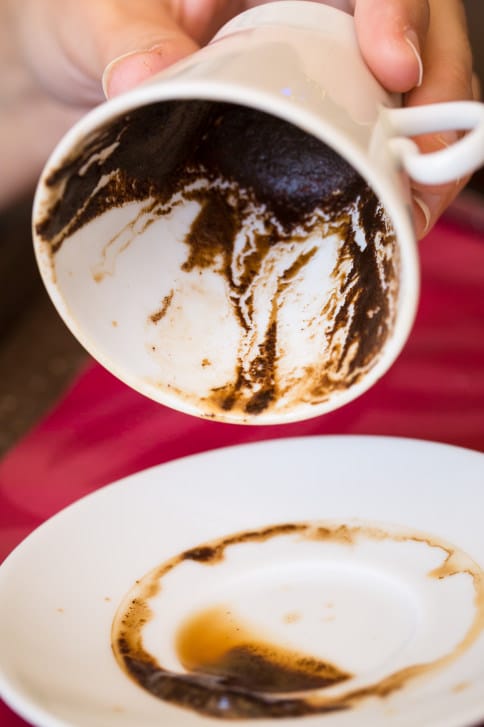
Here is an article about Greek coffee reading:
 www.greekboston.com
Art of Greek Coffee Fortune Telling
Here's more information on the art of Greek coffee fortune telling.
www.greekboston.com
One of the important assets to reading the coffee grounds is being a good story teller so you get the persons undivided attention and what you are saying/reading sounds plausible. My grandmother and her sister were both good at reading the coffee grounds but no one else in the family took up the practice. When we were in Alexandria, GR last year one of my female cousins was reading the coffee grounds and had the young ladies enthralled with what she saw as their future.
voula_slat
Active member
How did they learn to do the readings? Was it passed down in the family?One of the important assets to reading the coffee grounds is being a good story teller so you get the persons undivided attention and what you are saying/reading sounds plausible. My grandmother and her sister were both good at reading the coffee grounds but no one else in the family took up the practice. When we were in Alexandria, GR last year one of my female cousins was reading the coffee grounds and had the young ladies enthralled with what she saw as their future.
Yes it had to be that way. because my GM was born in 1894. I'll have to ask my cousin ib Greece where she learned the art of reading coffee grounds. When I find out I'll post the response.How did they learn to do the readings? Was it passed down in the family?
Interesting question. Brings to mind yet another question I wish I had asked my Yiayia before she passed! I'm thinking that if this were something I really wanted to know, this would be a good time to give the few 90+ yr. old Greek women I know a call in the nursing home where they reside..Does anyone know how to read the future using the grounds from a Greek coffee cup? It sounds so cool
Last edited:

xmelissaa
Active member
Hmmm that's so interesting. I wonder if I can learn from my family too. Is your family Alexandria, Egypt? My grandma was from there and she was very wiseI received a reply from my cousin in Alexandria. She said her grandmother taught her and if you have a good imagination its easy.

k_tsoukalas
Administrator
It seems like one of those things where if you have a good imagination and intuition, as well as being a great storyteller, you can easily "read the coffee grounds". It is a folklore tradition and on some level, I think that people use established teachings from an elder to develop the story. I don't know how to do it!
DanMichellB
Member
I gave coffee reading a try after watching a few tutorials, but I still wasn’t sure if I was seeing the symbols right. I ended up chatting with someone through www.trusted-psychics.co.uk, and they helped explain the patterns more clearly. It made a difference, especially since Greek coffee readings can feel confusing at first. They also shared how past readings connected with real situations, which helped me trust the process more.
1 - 11 of 11 Posts
JOIN THE DISCUSSION AND READ OTHER GREEK INFO:
Are most Greeks left or right?
- YiorgosGRK
- Greek Traditions Forum
- Replies: 2
Are most Greeks liberal leftist progressives? Most that I encounter are. Not only that but self hating. WHY?
Do younger generations still follow traditional Greek customs?
- mastichas09
- Greek Traditions Forum
- Replies: 1
Lately I’ve been wondering how much traditional Greek culture is still being carried forward by younger generations, both in Greece and in the diaspora.
I’m not talking only about the big holidays or major family events, but the smaller everyday things too — name days, church traditions, hospitality, family meals, fasting periods, village festivals, coffee rituals, respect for elders, even certain sayings and customs. Do younger Greeks still actively participate in these traditions, or do they mostly happen because parents and grandparents keep them going?
I imagine the answer probably depends a lot on location, family, and lifestyle. Someone growing up in a village might have a different experience than someone in Athens or abroad. I’d love to hear from people of different ages, which traditions have stayed strong, which ones are fading, and are there any that younger generations are bringing back in new ways?
What are your favorite name day traditions?
- paharo45
- Greek Traditions Forum
- Replies: 1
I’ve always loved the tradition of celebrating name days. In my family, they’re just as meaningful as birthdays, and sometimes even more fun because they bring everyone together in a different way.
When a big name day comes around, especially one that several family members share, we often turn it into a full family gathering. For example, on a name day like Nick/Nikolas, where there might be multiple people celebrating, it becomes almost like a mini family holiday. Someone hosts, there’s plenty of food, and everyone comes by to wish the celebrants “chronia polla.”
I also like the simplicity of the tradition. Even if there isn’t a big gathering, people still call or send messages to acknowledge the day.
Do you celebrate name days in your family? And are there certain ones that turn into larger celebrations because several people share the name?
Does your family make fanouropita for Saint Phanourios Day?
- mastichas09
- Greek Traditions Forum
- Replies: 1
I recently saw a news article about Saint Fanourios Day, and it showed people bringing fanouropita cakes to a church to be blessed. I knew about fanouropita and the tradition of making it when you’re hoping to find something that has been lost, but I didn’t realize how much of a church tradition it could be on the saint’s feast day itself.
Does your family make fanouropita for Saint Fanourios Day? If so, do you bring the cake to church to be blessed, or do you usually make it at home and share it with family and friends?
I’m also curious whether this is something that is still widely done in Greece or if it depends on the region, parish, or family. Are there any other traditions your family follows for Saint Fanourios Day?
I’d love to hear how people observe the day and whether fanouropita is part of your family’s tradition.
Greek Tsiknopempti Traditions?
- cubrinj
- Greek Traditions Forum
- Replies: 1
I realized Tsiknopempti is coming up soon, and it made me curious how everyone celebrates it, especially outside of Greece. Growing up, I always associated it with grilled meat, lots of smoke in the air, and a general feeling of celebration before Lent started, but we never had a really structured tradition at home. Now I’m wondering if I should start one.
Do you usually grill at home, go out to a Greek restaurant, or gather with friends and family? Are there certain foods you always make, or is it more about the atmosphere and being together? I’ve seen photos from Greece where entire neighborhoods are grilling outside, which looks amazing.
I’d love to hear what Tsiknopempti looks like for you, whether it’s something big and festive or just a simple meal that still feels meaningful.
Share and discuss Greek traditions related to Greek weddings, christenings, dance & holidays!
WorldwideGreeks.com is a free online forum community where people can discuss Greek food, travel, traditions, history and mythology.
Join Worldwide Greeks here!
Join Worldwide Greeks here!
JOIN COMMUNITY FOR FREE
LOGIN TO YOUR ACCOUNT