Menu
Install the app
How to install the app on iOS
Follow along with the video below to see how to install our site as a web app on your home screen.
Note: This feature may not be available in some browsers.
You are using an out of date browser. It may not display this or other websites correctly.
You should upgrade or use an alternative browser.
You should upgrade or use an alternative browser.
1 - 11 of 11 Posts


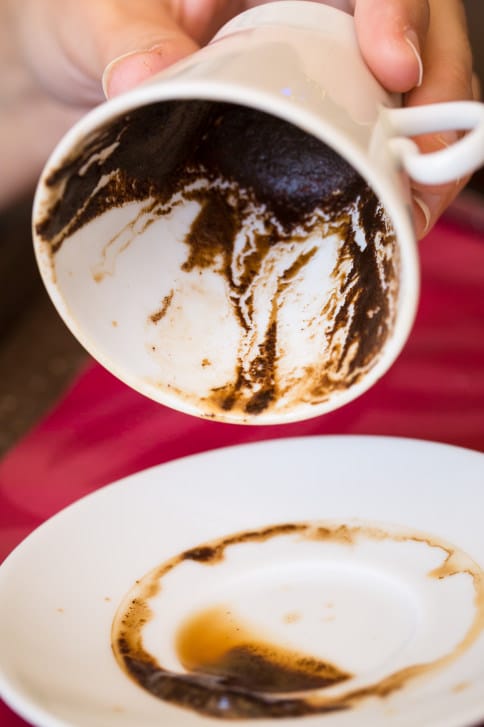
Here is an article about Greek coffee reading:
 www.greekboston.com
Art of Greek Coffee Fortune Telling
Here's more information on the art of Greek coffee fortune telling.
www.greekboston.com
One of the important assets to reading the coffee grounds is being a good story teller so you get the persons undivided attention and what you are saying/reading sounds plausible. My grandmother and her sister were both good at reading the coffee grounds but no one else in the family took up the practice. When we were in Alexandria, GR last year one of my female cousins was reading the coffee grounds and had the young ladies enthralled with what she saw as their future.
voula_slat
Active member
How did they learn to do the readings? Was it passed down in the family?One of the important assets to reading the coffee grounds is being a good story teller so you get the persons undivided attention and what you are saying/reading sounds plausible. My grandmother and her sister were both good at reading the coffee grounds but no one else in the family took up the practice. When we were in Alexandria, GR last year one of my female cousins was reading the coffee grounds and had the young ladies enthralled with what she saw as their future.
Yes it had to be that way. because my GM was born in 1894. I'll have to ask my cousin ib Greece where she learned the art of reading coffee grounds. When I find out I'll post the response.How did they learn to do the readings? Was it passed down in the family?
Interesting question. Brings to mind yet another question I wish I had asked my Yiayia before she passed! I'm thinking that if this were something I really wanted to know, this would be a good time to give the few 90+ yr. old Greek women I know a call in the nursing home where they reside..Does anyone know how to read the future using the grounds from a Greek coffee cup? It sounds so cool
Last edited:

xmelissaa
Active member
Hmmm that's so interesting. I wonder if I can learn from my family too. Is your family Alexandria, Egypt? My grandma was from there and she was very wiseI received a reply from my cousin in Alexandria. She said her grandmother taught her and if you have a good imagination its easy.

k_tsoukalas
Administrator
It seems like one of those things where if you have a good imagination and intuition, as well as being a great storyteller, you can easily "read the coffee grounds". It is a folklore tradition and on some level, I think that people use established teachings from an elder to develop the story. I don't know how to do it!
DanMichellB
Member
I gave coffee reading a try after watching a few tutorials, but I still wasn’t sure if I was seeing the symbols right. I ended up chatting with someone through www.trusted-psychics.co.uk, and they helped explain the patterns more clearly. It made a difference, especially since Greek coffee readings can feel confusing at first. They also shared how past readings connected with real situations, which helped me trust the process more.
1 - 11 of 11 Posts
JOIN THE DISCUSSION AND READ OTHER GREEK INFO:
What are your favorite name day traditions?
- paharo45
- Greek Traditions Forum
- Replies: 1
I’ve always loved the tradition of celebrating name days. In my family, they’re just as meaningful as birthdays, and sometimes even more fun because they bring everyone together in a different way.
When a big name day comes around, especially one that several family members share, we often turn it into a full family gathering. For example, on a name day like Nick/Nikolas, where there might be multiple people celebrating, it becomes almost like a mini family holiday. Someone hosts, there’s plenty of food, and everyone comes by to wish the celebrants “chronia polla.”
I also like the simplicity of the tradition. Even if there isn’t a big gathering, people still call or send messages to acknowledge the day.
Do you celebrate name days in your family? And are there certain ones that turn into larger celebrations because several people share the name?
Why do Greeks celebrate name days?
- auroracoor1
- Greek Traditions Forum
- Replies: 1
I grew up with name days being a big deal, and I’ve always wondered why they feel more important than birthdays for so many of us. I know they’re tied to the Greek Orthodox Church feast days and the saints we’re named after, but it feels like there’s something deeper going on culturally.
In my family, name days were always open-house style, people calling, stopping by, bringing sweets, and it felt very communal. Birthdays, on the other hand, were more low-key.
Do you feel like name days still carry that same weight today? Or has it changed depending on the generation or where you live?
How was your experience using a virtual concierge at a luxury resort?
- DemarcusGentry
- Greek Traditions Forum
- Replies: 1
Booked a fancy resort for a once-in-a-blue-moon getaway, and they keep hyping up this “virtual concierge” thing like it’s the next big miracle. I’m kinda torn. Part of me loves the idea of ditching phone calls, but part of me worries it’ll feel cold or glitchy, like talking to a chat bot instead of a real human who actually cares if my room smells weird or if I need extra towels. If you’ve used one before, was it helpful or just marketing fluff? I’m trying to figure out if I should trust it or just stick to the front desk.
How did your family spend summers in Greece?
- xmelissaa
- Greek Traditions Forum
- Replies: 2
I’m curious how many of you spent summers in Greece growing up.
My experience was a little different. My parents both worked full time, so we never packed up and spent entire summers in Greece the way some Greek families did. But I had friends and cousins who seemed to disappear every June and come back just before school started, full of stories about village life, island beaches, family gatherings, and adventures with cousins.
I always found those stories fascinating and sometimes wished I had experienced that myself.
For those of you who did spend summers in Greece, what was it like? Did you stay in a village, a city, or on an island? What did your typical days look like? Are there any traditions, memories, or experiences that still stand out to you today? I'd love to hear your stories!
What Does Philotimo Mean to You?
- kosta_karapinotis
- Greek Traditions Forum
- Replies: 1
I’ve been thinking a lot lately about the word, or really, the concept, of philotimo. It’s one of those Greek words that just doesn’t translate neatly into English. I was recently trying to explain it to a non-Greek friend, and I realized how difficult it is to put into words!
I ended up talking about ideas like honor, dignity, courage, generosity, and doing the right thing because it’s simply the right thing to do. I even used some historical examples, including the 300 Spartans at Thermopylae and the spirit of Ochi Day, to try to explain the sense of duty and selflessness that I associate with philotimo.
But I know the concept can also show up in much smaller, everyday ways. How would you explain philotimo to someone unfamiliar with Greek culture? What does the word mean to you personally?
Share and discuss Greek traditions related to Greek weddings, christenings, dance & holidays!
WorldwideGreeks.com is a free online forum community where people can discuss Greek food, travel, traditions, history and mythology.
Join Worldwide Greeks here!
Join Worldwide Greeks here!
JOIN COMMUNITY FOR FREE
LOGIN TO YOUR ACCOUNT