
Menu
Install the app
How to install the app on iOS
Follow along with the video below to see how to install our site as a web app on your home screen.
Note: This feature may not be available in some browsers.
You are using an out of date browser. It may not display this or other websites correctly.
You should upgrade or use an alternative browser.
You should upgrade or use an alternative browser.
Greek Food, Cooking and Recipe Community
Is baklava Greek or Turkish?
- Thread starter seleanor
- Start date
1 - 10 of 10 Posts

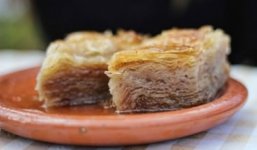

This is a big question! 
Since I am 100% Greek, I am going to say Greek!

Here are a few articles I found out about this:
https://www.greekboston.com/cooking/different-baklava/
https://theculturetrip.com/europe/turkey/articles/the-history-of-baklava-in-1-minute/
https://en.wikipedia.org/wiki/Baklava
https://libanaissweets.com/about-us/the-history-of-baklava/
Since I am 100% Greek, I am going to say Greek!
Here are a few articles I found out about this:
https://www.greekboston.com/cooking/different-baklava/
https://theculturetrip.com/europe/turkey/articles/the-history-of-baklava-in-1-minute/
https://en.wikipedia.org/wiki/Baklava
https://libanaissweets.com/about-us/the-history-of-baklava/
cf_fraiser
Active member
It's complicated! People from many different cultures and countries eat baklava. Since many people enjoy it, I would say why can't it be both?
Greeks lived a very long time in todays turkish territory and Greece was occupied by the ottomans for 400 years. I think is it very difficult to say from which part things come from. On my first trip to Greece (1973), coffee was called turkish coffee. Today you should not orderI don't mean to be controversial here...but I'm curious about the origins of baklava. I've heard a lot of debate, does anyone know where it comes from?
View attachment 199
it with this name. Why don't you just enjoy it and hope this two countries can live in peace one day.

k_tsoukalas
Administrator
It's complicated. Phyllo originated in Greece in the 3rd Century BC. There is a similar dessert in Ancient Greece that has the same filing but uses a different dough. Many believe that the dish itself came from the Byzantine Empire. The word baklava has Turkish origins, but that doesn't mean that the dessert wasn't Byzantine or Greek first, and then reabsorbed into he Greek Culture through the Turkish name for it (because of Ottoman occupation). Some credit the Syrians or Egyptians for making it first. It is popular throughout the Mediterranean and its origin hasn't been well documented, so all we can do is guess. I am Greek so I vote Greek, though!

d_kakavouli
Active member
I had no idea that once upon a time they called in Turkish coffee in Greece too!Greeks lived a very long time in todays turkish territory and Greece was occupied by the ottomans for 400 years. I think is it very difficult to say from which part things come from. On my first trip to Greece (1973), coffee was called turkish coffee. Today you should not order
it with this name. Why don't you just enjoy it and hope this two countries can live in peace one day.

byzantian
New member
Is it Greek or Turkish? If it comes to that choice, it is Greek, for the simple reason that filo pastry was known and made in Ancient Greece. What else did they have in Ancient Greece? They had honey and they had almonds and walnuts. And that was a long time before the Turks arrived on the scene. Now, whether the Greeks actually invented baklava or borrowed it from an earlier culture...who knows? Also we should remember that Arab pirates raided the Dodecanese islands from the 7th century (?) AD onwards and as well as looting they would have abducted Greek women and taken them off to their lands. This is one way ideas and skills are promulgated.
Last edited:
I love tasting the different versions! That's the beauty of baklavaTurks invented it, Greeks perfected it?
All kidding aside, every country adds their own spin to it, it all tastes delicious!
1 - 10 of 10 Posts
JOIN THE DISCUSSION AND READ OTHER GREEK INFO:
Do you make Greek lentil soup with vinegar
- acamp7
- Greek Food Forum
- Replies: 0
I’ve always made fakes with a splash of vinegar, either stirred into the pot near the end or added individually at the table. To me, that little bit of acidity is part of what makes the soup taste right, especially with the earthy lentils, olive oil, onion, garlic, and bay leaf.
But I have a Greek friend who makes hers very differently. She doesn’t use vinegar at all and instead adds quite a lot of tomato product, so her version is much redder and more tomato-forward than mine.
Now I’m curious about what is considered more traditional in Greek cooking. Is vinegar usually a standard part of fakes, or is it more of a regional or family preference? Are tomato-heavy versions just as traditional?
How do you make yours, and what did your family serve growing up?
But I have a Greek friend who makes hers very differently. She doesn’t use vinegar at all and instead adds quite a lot of tomato product, so her version is much redder and more tomato-forward than mine.
Now I’m curious about what is considered more traditional in Greek cooking. Is vinegar usually a standard part of fakes, or is it more of a regional or family preference? Are tomato-heavy versions just as traditional?
How do you make yours, and what did your family serve growing up?
Do you put potatoes in your briam?
- auroracoor1
- Greek Food Forum
- Replies: 0
I've noticed that there are quite a few variations of briam, especially when it comes to which vegetables people include. One ingredient I'm particularly curious about is potatoes. Do you always put potatoes in your briam, or do you prefer making it without them?
I usually think of briam as a combination of zucchini, eggplant, potatoes, tomatoes, onions, and plenty of olive oil. I love how the potatoes absorb all those wonderful flavors as everything slowly roasts together in the oven.
However, I've seen recipes that leave the potatoes out entirely and focus more on the summer vegetables. I imagine that makes the dish a little lighter.
I'm also curious whether there are regional differences in how briam is prepared throughout Greece. Does your family have a particular way of making it? And what vegetables do you consider absolutely essential?
I usually think of briam as a combination of zucchini, eggplant, potatoes, tomatoes, onions, and plenty of olive oil. I love how the potatoes absorb all those wonderful flavors as everything slowly roasts together in the oven.
However, I've seen recipes that leave the potatoes out entirely and focus more on the summer vegetables. I imagine that makes the dish a little lighter.
I'm also curious whether there are regional differences in how briam is prepared throughout Greece. Does your family have a particular way of making it? And what vegetables do you consider absolutely essential?
How Much Garlic in a Batch of Tzatziki?
- nadellii
- Greek Food Forum
- Replies: 0
How much garlic do you usually put in a batch of tzatziki? I think I may be using a little too much. I usually make mine with about 2 cups of Greek yogurt and 4 cloves of garlic, along with cucumber, olive oil, and the other usual ingredients.
It tastes great when I first make it, but we usually take about three days to finish the batch. By the second or third day, the garlic flavor and smell become really strong. Some people in my household love that and don’t mind it at all, but others think it becomes a bit overpowering. I’m starting to agree that four cloves might be too much, especially since the garlic seems to get stronger as it sits.
What do you all do? How many cloves would you use for about 2 cups of Greek yogurt?
It tastes great when I first make it, but we usually take about three days to finish the batch. By the second or third day, the garlic flavor and smell become really strong. Some people in my household love that and don’t mind it at all, but others think it becomes a bit overpowering. I’m starting to agree that four cloves might be too much, especially since the garlic seems to get stronger as it sits.
What do you all do? How many cloves would you use for about 2 cups of Greek yogurt?
What Greek Foods Do You Start Craving in the Fall?
- kcixcy
- Greek Food Forum
- Replies: 1
I've been thinking more about seasonal eating lately, especially from a Greek perspective. Summer Greek food feels so naturally tied to the season with tomatoes, zucchini, eggplant, fresh herbs, grilled foods, and plenty of fruit. But once the weather starts cooling down, I find myself wondering what traditional Greek foods really feel like fall.
Are there certain dishes you start making as soon as September or October arrives? I'm thinking of foods like fasolada, giouvetsi, trahana soup, baked dishes, savory pies, and recipes using apples, grapes, walnuts, chestnuts, pumpkin, or other fall ingredients.
I'd especially love to hear about foods that were seasonal in your family rather than dishes you ate year-round. Were there certain meals your yiayia or parents always started making when the weather changed?
What Greek foods make you think, "Okay, fall is officially here"?
Are there certain dishes you start making as soon as September or October arrives? I'm thinking of foods like fasolada, giouvetsi, trahana soup, baked dishes, savory pies, and recipes using apples, grapes, walnuts, chestnuts, pumpkin, or other fall ingredients.
I'd especially love to hear about foods that were seasonal in your family rather than dishes you ate year-round. Were there certain meals your yiayia or parents always started making when the weather changed?
What Greek foods make you think, "Okay, fall is officially here"?
Favorite Greek Cheeses Beyond Feta
- nm1999
- Greek Food Forum
- Replies: 0
Feta gets most of the attention when people talk about Greek cheese, but there are so many other varieties worth trying. I’m curious which Greek cheeses everyone enjoys most beyond feta.
Graviera is one of my favorites because it works so well on a cheese plate, grated over dishes, or just eaten with bread. Kasseri is another one I really like, especially melted. I’ve also been interested in trying more regional cheeses like metsovone, manouri, kefalotyri, and formaela.
Some Greek cheeses seem to be much easier to find outside Greece than others, so I’d also love to know which ones people regularly buy and where they usually find them.
What Greek cheeses do you keep coming back to? Are there certain ones you associate with a particular region, dish, or family tradition? And if someone has mostly eaten feta, which Greek cheese would you recommend they try next?
Graviera is one of my favorites because it works so well on a cheese plate, grated over dishes, or just eaten with bread. Kasseri is another one I really like, especially melted. I’ve also been interested in trying more regional cheeses like metsovone, manouri, kefalotyri, and formaela.
Some Greek cheeses seem to be much easier to find outside Greece than others, so I’d also love to know which ones people regularly buy and where they usually find them.
What Greek cheeses do you keep coming back to? Are there certain ones you associate with a particular region, dish, or family tradition? And if someone has mostly eaten feta, which Greek cheese would you recommend they try next?
Sign up for a free account and share your thoughts, photos, questions about Greek food, travel and culture!
WorldwideGreeks.com is a free online forum community where people can discuss Greek food, travel, traditions, history and mythology.
Join Worldwide Greeks here!
Join Worldwide Greeks here!
JOIN COMMUNITY FOR FREE
LOGIN TO YOUR ACCOUNT

