
Menu
Install the app
How to install the app on iOS
Follow along with the video below to see how to install our site as a web app on your home screen.
Note: This feature may not be available in some browsers.
You are using an out of date browser. It may not display this or other websites correctly.
You should upgrade or use an alternative browser.
You should upgrade or use an alternative browser.
Greek Food, Cooking and Recipe Community
Is baklava Greek or Turkish?
- Thread starter seleanor
- Start date
1 - 10 of 10 Posts

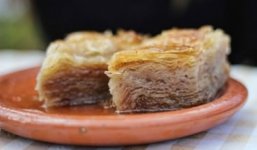

This is a big question! 
Since I am 100% Greek, I am going to say Greek!

Here are a few articles I found out about this:
https://www.greekboston.com/cooking/different-baklava/
https://theculturetrip.com/europe/turkey/articles/the-history-of-baklava-in-1-minute/
https://en.wikipedia.org/wiki/Baklava
https://libanaissweets.com/about-us/the-history-of-baklava/
Since I am 100% Greek, I am going to say Greek!
Here are a few articles I found out about this:
https://www.greekboston.com/cooking/different-baklava/
https://theculturetrip.com/europe/turkey/articles/the-history-of-baklava-in-1-minute/
https://en.wikipedia.org/wiki/Baklava
https://libanaissweets.com/about-us/the-history-of-baklava/
cf_fraiser
Active member
It's complicated! People from many different cultures and countries eat baklava. Since many people enjoy it, I would say why can't it be both?
Greeks lived a very long time in todays turkish territory and Greece was occupied by the ottomans for 400 years. I think is it very difficult to say from which part things come from. On my first trip to Greece (1973), coffee was called turkish coffee. Today you should not orderI don't mean to be controversial here...but I'm curious about the origins of baklava. I've heard a lot of debate, does anyone know where it comes from?
View attachment 199
it with this name. Why don't you just enjoy it and hope this two countries can live in peace one day.

k_tsoukalas
Administrator
It's complicated. Phyllo originated in Greece in the 3rd Century BC. There is a similar dessert in Ancient Greece that has the same filing but uses a different dough. Many believe that the dish itself came from the Byzantine Empire. The word baklava has Turkish origins, but that doesn't mean that the dessert wasn't Byzantine or Greek first, and then reabsorbed into he Greek Culture through the Turkish name for it (because of Ottoman occupation). Some credit the Syrians or Egyptians for making it first. It is popular throughout the Mediterranean and its origin hasn't been well documented, so all we can do is guess. I am Greek so I vote Greek, though!

d_kakavouli
Active member
I had no idea that once upon a time they called in Turkish coffee in Greece too!Greeks lived a very long time in todays turkish territory and Greece was occupied by the ottomans for 400 years. I think is it very difficult to say from which part things come from. On my first trip to Greece (1973), coffee was called turkish coffee. Today you should not order
it with this name. Why don't you just enjoy it and hope this two countries can live in peace one day.

byzantian
New member
Is it Greek or Turkish? If it comes to that choice, it is Greek, for the simple reason that filo pastry was known and made in Ancient Greece. What else did they have in Ancient Greece? They had honey and they had almonds and walnuts. And that was a long time before the Turks arrived on the scene. Now, whether the Greeks actually invented baklava or borrowed it from an earlier culture...who knows? Also we should remember that Arab pirates raided the Dodecanese islands from the 7th century (?) AD onwards and as well as looting they would have abducted Greek women and taken them off to their lands. This is one way ideas and skills are promulgated.
Last edited:
I love tasting the different versions! That's the beauty of baklavaTurks invented it, Greeks perfected it?
All kidding aside, every country adds their own spin to it, it all tastes delicious!
1 - 10 of 10 Posts
JOIN THE DISCUSSION AND READ OTHER GREEK INFO:
How does your family season dolmades?
- mastichas09
- Greek Food Forum
- Replies: 0
I’ve been thinking about how much dolmades can vary from one family to another, especially when it comes to seasoning. Even when the basic ingredients are similar, the flavor can be completely different depending on which herbs and spices are used.
How does your family season dolmades? Do you use mostly dill and parsley, or do you add mint as well? I’ve also seen recipes that include green onions, oregano, or even a little cinnamon, especially when meat is part of the filling.
I’m curious whether you season the rice mixture pretty heavily before rolling the grape leaves or keep it simple and let the lemon and olive oil provide most of the flavor. Does your family add lemon juice directly to the filling, or only during cooking and serving?
I’d especially love to hear about any regional or family traditions. What gives your dolmades their distinctive flavor?
How does your family season dolmades? Do you use mostly dill and parsley, or do you add mint as well? I’ve also seen recipes that include green onions, oregano, or even a little cinnamon, especially when meat is part of the filling.
I’m curious whether you season the rice mixture pretty heavily before rolling the grape leaves or keep it simple and let the lemon and olive oil provide most of the flavor. Does your family add lemon juice directly to the filling, or only during cooking and serving?
I’d especially love to hear about any regional or family traditions. What gives your dolmades their distinctive flavor?
Greek cooking without a recipe?
- AlexiaTravels
- Greek Food Forum
- Replies: 0
I've been thinking about how much traditional Greek cooking relies on instinct rather than following exact recipes. Some of the Greek dishes I learned to make were taught to me by feel, with someone showing me what to do rather than measuring everything out.
I actually enjoy cooking this way, but I've noticed that it can make certain dishes difficult to recreate consistently! Sometimes everything comes together perfectly, and other times I wonder what I did differently.
I'm curious how others approach this. Did you learn Greek cooking by watching your yiayia, mother, or other relatives? Do you measure ingredients, or do you just know when something looks, smells, or tastes right?
I actually enjoy cooking this way, but I've noticed that it can make certain dishes difficult to recreate consistently! Sometimes everything comes together perfectly, and other times I wonder what I did differently.
I'm curious how others approach this. Did you learn Greek cooking by watching your yiayia, mother, or other relatives? Do you measure ingredients, or do you just know when something looks, smells, or tastes right?
Do you make your pastitsio with a thick or thin layer of krema?
- axariotisxy
- Greek Food Forum
- Replies: 0
I've always preferred my pastitsio with a nice, thick layer of béchamel on top. To me, that's one of the best parts of the dish! I love when the krema is rich, creamy, and thick enough to hold its shape when you cut into the pastitsio.
The problem is that I've been having trouble getting my krema just right. Sometimes it comes out too thin, and other times the texture isn't quite as smooth as I'd like. I've tried adjusting the amount of flour and milk, but I still haven't found the perfect balance.
I'm curious how everyone else makes theirs. Do you prefer a thick layer of béchamel or just enough to cover the pasta? Does your family add eggs or cheese to the mixture?
I'd especially love to hear any tips for making a thick, smooth krema that sets beautifully when baked!
The problem is that I've been having trouble getting my krema just right. Sometimes it comes out too thin, and other times the texture isn't quite as smooth as I'd like. I've tried adjusting the amount of flour and milk, but I still haven't found the perfect balance.
I'm curious how everyone else makes theirs. Do you prefer a thick layer of béchamel or just enough to cover the pasta? Does your family add eggs or cheese to the mixture?
I'd especially love to hear any tips for making a thick, smooth krema that sets beautifully when baked!
Do You Put Cinnamon in Your Keftedes?
- nadellii
- Greek Food Forum
- Replies: 0
I’m curious how everyone here makes keftedes, especially when it comes to cinnamon. I know some Greek families add a little cinnamon to the meat mixture, while others would never think of putting it in.
In my experience, even a small amount can change the flavor quite a bit. It gives the keftedes a warmer, slightly sweeter spice in the background, but I can also see how it might not be for everyone. I’ve had versions that lean more heavily on oregano, mint, parsley, garlic, and onion instead.
Do you put cinnamon in your keftedes? If you do, how much do you usually use, and was that something your family always did? I’d also be curious to know if it varies depending on what part of Greece your family comes from.
Would love to hear how everyone seasons theirs and what you consider essential for really good keftedes.
In my experience, even a small amount can change the flavor quite a bit. It gives the keftedes a warmer, slightly sweeter spice in the background, but I can also see how it might not be for everyone. I’ve had versions that lean more heavily on oregano, mint, parsley, garlic, and onion instead.
Do you put cinnamon in your keftedes? If you do, how much do you usually use, and was that something your family always did? I’d also be curious to know if it varies depending on what part of Greece your family comes from.
Would love to hear how everyone seasons theirs and what you consider essential for really good keftedes.
What is your favorite Greek potato dish?
- mastichas09
- Greek Food Forum
- Replies: 0
Potatoes show up in so many Greek meals, and I think they are often at their best when they soak up plenty of olive oil, lemon, herbs, and cooking juices.
Greek lemon potatoes are probably the first thing that comes to mind for me. I love when they are roasted until they are soft inside, a little crisp around the edges, and full of lemon and oregano. Potatoes cooked alongside chicken or lamb are also hard to beat because they absorb so much flavor from the pan.
I also enjoy simple boiled potatoes dressed with olive oil, lemon, parsley, and salt, especially with fish or grilled meat.
What Greek potato dish do you make most often? Do you prefer lemon potatoes, potatoes roasted with meat, fried potatoes, or something else? And is there a particular seasoning or family method that makes your version especially good?
Greek lemon potatoes are probably the first thing that comes to mind for me. I love when they are roasted until they are soft inside, a little crisp around the edges, and full of lemon and oregano. Potatoes cooked alongside chicken or lamb are also hard to beat because they absorb so much flavor from the pan.
I also enjoy simple boiled potatoes dressed with olive oil, lemon, parsley, and salt, especially with fish or grilled meat.
What Greek potato dish do you make most often? Do you prefer lemon potatoes, potatoes roasted with meat, fried potatoes, or something else? And is there a particular seasoning or family method that makes your version especially good?
Sign up for a free account and share your thoughts, photos, questions about Greek food, travel and culture!
WorldwideGreeks.com is a free online forum community where people can discuss Greek food, travel, traditions, history and mythology.
Join Worldwide Greeks here!
Join Worldwide Greeks here!
JOIN COMMUNITY FOR FREE
LOGIN TO YOUR ACCOUNT

