1 - 6 of 6 Posts

kosta_karapinotis

Active member
I've noticed so many similarities, but when it comes down to it: what are the differences between the two architecture styles?
 
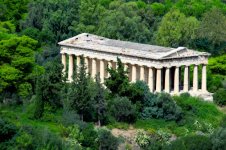
The difference is in the pillars! From afar, the pillars look very similar (like in this picture). But the top of the pillars is different. Greek architecture follows the golden rule, which is shape that can be wholly divided into up into a square and a rectangle that, when combined, establish a ratio of 1:1.61.

acropolis.jpg
 
All Roman architecture is Greek
The Italians are the Chinese of Europe, they copied everything from the Greeks.
 
The differences are there, even if they're subtle. Even in Ancient Greece, there are different architectural styles that were common during different time periods. It's really hard to generalize!
 
I reword my statement.
All Roman architecture originated from the Greeks. Is that better?
 

Information about the Battle of Marathon

I'm planning a trip to Greece later this year, and one of the places I'm really hoping to visit is the site of the Battle of Marathon. I've read the basic history and know it was one of the most important battles of the Persian Wars, but I'd love to learn more before I actually stand where it happened.

For those of you who have visited Marathon or have studied this period of Greek history, what details or stories do you think are especially worth knowing? Are there any books, documentaries, or articles you'd recommend beforehand? Is there anything at the site that many visitors overlook or don't fully appreciate without some background?

I'd really like to understand not just the battle itself, but why it became such a defining moment in Greek history. Thanks in advance for any suggestions!

Daily Life in Ancient Athens?

When I visited Athens recently, I spent a lot of time walking around the ancient sites like the Acropolis of Athens and the Ancient Agora of Athens. Seeing the ruins up close was incredible, but it also made my imagination wander.

As I walked through the Agora and looked up at the Acropolis, I kept wondering what daily life was actually like in Ancient Athens. What did an ordinary day look like for people who lived there? Were the streets busy with merchants and philosophers debating ideas? What kinds of foods were people cooking, and how did families spend their evenings?

It’s easy to think about the big historical moments or famous figures, but I’m really curious about everyday life. What were homes like, how did people spend their time, and what might a normal day have looked like for the average Athenian? I’d love to hear any insights or resources people recommend!

Fall of the City States (Polis)

I’ve been reading more about ancient Greek history lately, and something struck me — we always hear about the rise of the polis and how important city-states like Athens and Sparta were, but I don’t see as much discussion about how that system actually declined.

What led to the fall of the polis as the dominant structure in Greek life? Was it mainly due to constant warfare like the Peloponnesian War, or did larger powers like Macedon gradually make the independent city-state model obsolete?

I’m especially curious about whether this was a sudden shift or more of a slow transition over time. Did people living through it even realize the polis era was ending?

I’d love to gather more insight on this. Greek history is a big interest of mine, and this feels like an important piece I haven’t fully understood yet.

Why does the Battle of Thermopylae still capture so much attention?

The Battle of Thermopylae is one of those moments in Greek history that still seems to capture people's attention thousands of years later. The story of Leonidas and the small Greek force standing against the much larger Persian army has become a symbol of courage, sacrifice, and resistance against overwhelming odds.

Of course, the real history is more complicated than the legend, and Thermopylae was only one part of the larger Greco-Persian Wars. Still, there is something powerful about the idea of people choosing to hold their ground even when they know the outcome may not be in their favor.

I also think modern books, movies, and popular culture have helped keep the story alive, sometimes blending history with mythology. Why do you think the Battle of Thermopylae still fascinates people so much? Is it the history itself, the symbolism, or the legend that grew around it?

Learning About Ancient Corinth

I’m hoping to visit the ruins of Ancient Corinth on a future trip to Greece, and I’d like to learn more about the history before I go. I always find that I appreciate archaeological sites more when I understand what I’m looking at and know some of the stories behind the ruins.

For those who have visited Ancient Corinth, what would you recommend learning about beforehand? Are there particular periods of the city’s history, important events, or historical figures that help put the site into context? I know Corinth had an important location and a long history, but I’d like to understand more about how the city developed and changed over time.

I’d also love recommendations for books, documentaries, podcasts, or other resources that give a good introduction to Ancient Corinth. What helped you understand the site and its history before or after your visit?
Share and discuss Greek history!

WorldwideGreeks.com is a free online forum community where people can discuss Greek food, travel, traditions, history and mythology.
Join Worldwide Greeks here!

JOIN COMMUNITY FOR FREE

LOGIN TO YOUR ACCOUNT
Back
Top