1 - 6 of 6 Posts

kosta_karapinotis

Active member
I've noticed so many similarities, but when it comes down to it: what are the differences between the two architecture styles?
 
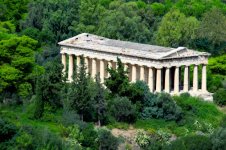
The difference is in the pillars! From afar, the pillars look very similar (like in this picture). But the top of the pillars is different. Greek architecture follows the golden rule, which is shape that can be wholly divided into up into a square and a rectangle that, when combined, establish a ratio of 1:1.61.

acropolis.jpg
 
All Roman architecture is Greek
The Italians are the Chinese of Europe, they copied everything from the Greeks.
 
The differences are there, even if they're subtle. Even in Ancient Greece, there are different architectural styles that were common during different time periods. It's really hard to generalize!
 
I reword my statement.
All Roman architecture originated from the Greeks. Is that better?
 

Themistocles: Hero, Politician, or Master Strategist?

This weekend I met someone named Themistocles, which immediately caught my attention. We ended up having a conversation about the famous Athenian statesman and general, and it got me thinking more about his place in Greek history.

Themistocles is often credited with recognizing the importance of naval power and helping secure the Greek victory at the Battle of Salamis. Without his foresight and strategy, the Persian Wars may have had a very different outcome. At the same time, he was also a politician who made powerful enemies and was eventually ostracized from Athens.

It made me wonder how people today view him. Was he primarily a hero who helped save Greece, a brilliant politician navigating a difficult era, or one of history's greatest military strategists? I'd love to hear your thoughts on his legacy and whether you think he gets the recognition he deserves.

Information about the Battle of Marathon

I'm planning a trip to Greece later this year, and one of the places I'm really hoping to visit is the site of the Battle of Marathon. I've read the basic history and know it was one of the most important battles of the Persian Wars, but I'd love to learn more before I actually stand where it happened.

For those of you who have visited Marathon or have studied this period of Greek history, what details or stories do you think are especially worth knowing? Are there any books, documentaries, or articles you'd recommend beforehand? Is there anything at the site that many visitors overlook or don't fully appreciate without some background?

I'd really like to understand not just the battle itself, but why it became such a defining moment in Greek history. Thanks in advance for any suggestions!

How Democratic Was Athenian Democracy?

I’ve been studying the democracy of Athens lately, and I find it fascinating that such an influential system didn’t actually last very long in its original form. It’s often described as the birthplace of democracy, and yet when you look closely, it seems both groundbreaking and limited at the same time.

On the one hand, the idea of citizens participating directly in decision-making was radical. On the other hand, citizenship excluded women, enslaved people, and foreigners, which dramatically narrowed who had a voice. It makes me wonder how “democratic” it really was by its own standards, let alone ours.

I’m also curious how stable it truly felt at the time, given the political upheavals and eventual decline.

For those who’ve studied this period more deeply, how do you interpret Athenian democracy? Do you see it as a bold experiment that laid the groundwork for modern systems, or as something far more fragile and constrained?

Period of Greek History You Find the Most Fascinating?

One of the things I love most about visiting Greece is how layered the history feels. You can be standing in one place and realize people have been living there for thousands of years across completely different eras.

So far, I’ve been especially drawn to Minoan history, places like Knossos really stayed with me, and also sites connected to the New Testament. Visiting locations tied to early Christianity adds a whole different dimension to travel for me.

Lately I’ve been thinking about planning future trips around specific historical periods, but Greece has so many that it’s hard to know where to focus next. Ancient classical sites, Byzantine monasteries, Ottoman-era towns, Venetian fortresses, it’s almost overwhelming in a good way.

I’d love to hear what periods of Greek history you personally find most fascinating, and why. Are there particular places that really brought that era to life for you? I’m looking for inspiration for future exploring.

Greek life under Roman rule?

I’ve been reading more about Greek history lately, especially periods that don’t get as much everyday attention, and I keep coming back to Greek life under Roman Empire rule.

I know the broad timeline, Greece absorbed into the Roman world, cities continuing to function, Greek culture influencing Rome as much as the other way around — but I’m really curious about the lived experience. What did daily life actually feel like for ordinary Greeks during this period? How much continuity was there with earlier Hellenistic life, and where did Roman administration, law, or customs really change things?

I love history most when I can picture it: streets, homes, education, food, language, religion. Were people aware they were living in a “Roman” era, or did it feel like Greek life with a new layer on top?

If anyone has thoughts, favorite books, articles, documentaries, or even museum resources, I’d love recommendations.

Share and discuss Greek history!

WorldwideGreeks.com is a free online forum community where people can discuss Greek food, travel, traditions, history and mythology.
Join Worldwide Greeks here!

JOIN COMMUNITY FOR FREE

LOGIN TO YOUR ACCOUNT
Back
Top