1 - 5 of 5 Posts

blopez34

Active member
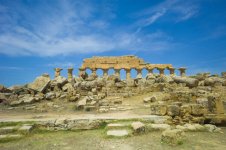
I don't want to get too controversial here and I know that this is super contested, but is it possible that an earthquake caused the fall of the Greek bronze age? How can such a powerful empire collapsed as a result of the environment? I mean just look at this architecture... Thoughts?

Ancient-Greece-720x479.jpg
 
The Bronze Age collapse is a hot topic. First, historians don't agree as to when it collapsed. Second, people can't agree if it was a natural event, like the earthquake you speak of, that caused it or if it correlated with foreign invasion. Some historians adopt a "one or the other" mindset, others think it was a combination of factors. I've even seen that some speculate that there may have been a plague that contributed. Some researchers have traced the infamous bubonic plague as originating in the Greek Bronze Age.
 
  • Like
Reactions: acamp7
Don't underestimate the power of mother nature! I don't doubt that an earthquake played a role, but my guess is that it was a combination of a lot of things. Most of them environmental, there's a lot of speculation that there was also many droughts happening at the time. So all these compounding factors could've had a big impact on the civilization.
 
All of these answers could be true. But I do think that such a strong civilization could only fall from an attack. There are many accounts of tribes “from the sea” or “sea people” that were attacking nearby regions at the time.
 
I don't want to get too controversial here and I know that this is super contested, but is it possible that an earthquake caused the fall of the Greek bronze age? How can such a powerful empire collapsed as a result of the environment? I mean just look at this architecture... Thoughts?

View attachment 74
Good morning, We have our first visit to Greece scheduled in November and I have been watching some DVD lectures from The Great Courses. Professor McInerny of University of Pennsylvania discussed the end of Bronze Age in one of his lectures. According to him , although there was a massive volcanic eruption on an island about 200 miles north of Crete ( Thera if I recall correctly) there is archaeological evidence that the Minoan settlements on the northern coast of Crete rebuilt after the damage from that event. Professor McInerny theorized that the eruption may have caused substantial damage to Minoan Cretan naval power and economic power but did not end Bronze Age Greek civilization. Based on pottery finds, supposedly Minoan Crete declined several centuries after that volcanic eruption on Thera and Mycenae went into decline even later. I am not a shill for The Great Courses but I do enjoy learning about places before visiting them and recommend combining watching lectures while exercising on the treadmill.
 

How Democratic Was Athenian Democracy?

I’ve been studying the democracy of Athens lately, and I find it fascinating that such an influential system didn’t actually last very long in its original form. It’s often described as the birthplace of democracy, and yet when you look closely, it seems both groundbreaking and limited at the same time.

On the one hand, the idea of citizens participating directly in decision-making was radical. On the other hand, citizenship excluded women, enslaved people, and foreigners, which dramatically narrowed who had a voice. It makes me wonder how “democratic” it really was by its own standards, let alone ours.

I’m also curious how stable it truly felt at the time, given the political upheavals and eventual decline.

For those who’ve studied this period more deeply, how do you interpret Athenian democracy? Do you see it as a bold experiment that laid the groundwork for modern systems, or as something far more fragile and constrained?

Which period of Greek history interests you the most?

Which period of Greek history interests you the most? There are so many fascinating eras that it can be difficult to choose just one.

Ancient Greece usually gets the most attention, especially Classical Athens, Sparta, the Persian Wars, and Alexander the Great. But I also find the Byzantine period fascinating because of its enormous influence on Greek religion, culture, art, and identity. Then there are the centuries of Ottoman rule, the Greek War of Independence, the Asia Minor Catastrophe, and Greece’s experiences during the World Wars and Civil War.

I’m curious which period everyone here finds themselves reading about most often. Is there a particular era, historical figure, battle, city, or event that drew you into Greek history?

I’d also love to hear about periods you think deserve more attention. Which part of Greek history would you recommend someone explore if they wanted to go beyond the usual ancient Greece topics?

Greek life under Roman rule?

I’ve been reading more about Greek history lately, especially periods that don’t get as much everyday attention, and I keep coming back to Greek life under Roman Empire rule.

I know the broad timeline, Greece absorbed into the Roman world, cities continuing to function, Greek culture influencing Rome as much as the other way around — but I’m really curious about the lived experience. What did daily life actually feel like for ordinary Greeks during this period? How much continuity was there with earlier Hellenistic life, and where did Roman administration, law, or customs really change things?

I love history most when I can picture it: streets, homes, education, food, language, religion. Were people aware they were living in a “Roman” era, or did it feel like Greek life with a new layer on top?

If anyone has thoughts, favorite books, articles, documentaries, or even museum resources, I’d love recommendations.

Learning About Ancient Corinth

I’m hoping to visit the ruins of Ancient Corinth on a future trip to Greece, and I’d like to learn more about the history before I go. I always find that I appreciate archaeological sites more when I understand what I’m looking at and know some of the stories behind the ruins.

For those who have visited Ancient Corinth, what would you recommend learning about beforehand? Are there particular periods of the city’s history, important events, or historical figures that help put the site into context? I know Corinth had an important location and a long history, but I’d like to understand more about how the city developed and changed over time.

I’d also love recommendations for books, documentaries, podcasts, or other resources that give a good introduction to Ancient Corinth. What helped you understand the site and its history before or after your visit?

Most forgotten period of Greek history?

I was in Crete once eating at a restaurant and there was a pile of artifacts heaped - broken pottery shards, etc. The restaurant told us that they were going to throw them out. I said, but they are artifacts, why?! They said that no one cares about that time period the artifacts came from - something about an Arabic occupation.

I thought it was interesting and it stayed with me nearly two decades later. This is clearly a forgotten period of Greek history. Does this happen a lot in Greece? Got me thinking about Greek history and what else may be forgotten... Would love your thoughts.
Share and discuss Greek history!

WorldwideGreeks.com is a free online forum community where people can discuss Greek food, travel, traditions, history and mythology.
Join Worldwide Greeks here!

JOIN COMMUNITY FOR FREE

LOGIN TO YOUR ACCOUNT
Back
Top

