1 - 11 of 11 Posts

efhernandez_

Active member
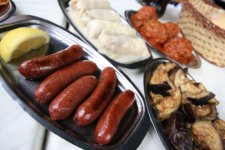
Loukanika are so amazing! Greeks really know how to make some of the most juicy and flavourful meat. If anyone has any good restaurants in the Austin, Texas area that they could recommend for some great Greek food and loukanika I would really appreciate it :)
Loukanika-Greek-Sausage-720x480.jpg
 
Loukanika are so amazing! Greeks really know how to make some of the most juicy and flavourful meat. If anyone has any good restaurants in the Austin, Texas area that they could recommend for some great Greek food and loukanika I would really appreciate it :)
View attachment 850
Everyone loves a bit of Greek loukaniko
 
You can also find recipes online on how to make your own! My family used to do this. I love the way everyone has their own recipe. For me, it is the orange peel that really makes it special.
 
  • Like
Reactions: nadellii
You can also find recipes online on how to make your own! My family used to do this. I love the way everyone has their own recipe. For me, it is the orange peel that really makes it special.
Ive never tried it with orange! I usually use rosemary and thyme
 
  • Like
Reactions: lalajess
Ive never tried it with orange! I usually use rosemary and thyme
Some of my family I suspect might have roots on Crete, though that information got lost. From what I understand, there are a ton of orange trees on the island, so many of our family dishes involve oranges. I've actually never had it with rosemary for some reason!
 
  • Like
Reactions: acamp7
Some of my family I suspect might have roots on Crete, though that information got lost. From what I understand, there are a ton of orange trees on the island, so many of our family dishes involve oranges. I've actually never had it with rosemary for some reason!
So sad that so much information like that is lost in Greece. My relative said that a lot of documents got lost because of Turkish occupation. I wonder if that's what happened in your case
 
  • Like
Reactions: lalajess
So sad that so much information like that is lost in Greece. My relative said that a lot of documents got lost because of Turkish occupation. I wonder if that's what happened in your case
It's possible! I heard the same thing. Many of the records were lost or destroyed. Some burned. Also in the later generations, no one thought to ask the surviving relatives, and now they're gone!
 
  • Like
Reactions: mj_toronto8
It's possible! I heard the same thing. Many of the records were lost or destroyed. Some burned. Also in the later generations, no one thought to ask the surviving relatives, and now they're gone!
So sad, I have researched and seem some super old interviews of elderly Greek people describing their experiences in Asia Minor. Im glad few have gone out to document Greek history
 
So sad, I have researched and seem some super old interviews of elderly Greek people describing their experiences in Asia Minor. Im glad few have gone out to document Greek history
Same here - I know some families who have roots in Asia Minor and had to move abruptly. Only one of these families thought to film a survivor before she passed talking about what she remembered, and what she remembered her mother talking about.
 
I love the recipe that involves spicing it with orange peels, but I have also had versions that have a dominant fennel or anise flavor, and those are great, as well. I don't always like "heat" in Greek cooking, but my favorite of the Greek sausages are always on the spicier side.
 

Do you make your pastitsio with a thick or thin layer of krema?

I've always preferred my pastitsio with a nice, thick layer of béchamel on top. To me, that's one of the best parts of the dish! I love when the krema is rich, creamy, and thick enough to hold its shape when you cut into the pastitsio.

The problem is that I've been having trouble getting my krema just right. Sometimes it comes out too thin, and other times the texture isn't quite as smooth as I'd like. I've tried adjusting the amount of flour and milk, but I still haven't found the perfect balance.

I'm curious how everyone else makes theirs. Do you prefer a thick layer of béchamel or just enough to cover the pasta? Does your family add eggs or cheese to the mixture?

I'd especially love to hear any tips for making a thick, smooth krema that sets beautifully when baked!

Do you put potatoes in your briam?

I've noticed that there are quite a few variations of briam, especially when it comes to which vegetables people include. One ingredient I'm particularly curious about is potatoes. Do you always put potatoes in your briam, or do you prefer making it without them?

I usually think of briam as a combination of zucchini, eggplant, potatoes, tomatoes, onions, and plenty of olive oil. I love how the potatoes absorb all those wonderful flavors as everything slowly roasts together in the oven.

However, I've seen recipes that leave the potatoes out entirely and focus more on the summer vegetables. I imagine that makes the dish a little lighter.

I'm also curious whether there are regional differences in how briam is prepared throughout Greece. Does your family have a particular way of making it? And what vegetables do you consider absolutely essential?

Greek cooking without a recipe?

I've been thinking about how much traditional Greek cooking relies on instinct rather than following exact recipes. Some of the Greek dishes I learned to make were taught to me by feel, with someone showing me what to do rather than measuring everything out.

I actually enjoy cooking this way, but I've noticed that it can make certain dishes difficult to recreate consistently! Sometimes everything comes together perfectly, and other times I wonder what I did differently.

I'm curious how others approach this. Did you learn Greek cooking by watching your yiayia, mother, or other relatives? Do you measure ingredients, or do you just know when something looks, smells, or tastes right?

Is lamb or beef more traditional for giouvetsi?

I've been looking into traditional Greek giouvetsi recipes lately, and I'm curious about which meat is considered the most traditional. I've seen recipes that use lamb, others that call for beef, and even some that use chicken.

I love the idea of slowly cooking the meat in a rich tomato sauce with orzo until everything becomes tender and flavorful. However, I'm wondering whether lamb or beef would be the more authentic choice.

Is one traditionally preferred in certain regions of Greece? I've read that lamb is often associated with older Greek recipes, but beef seems to be very common in modern versions of giouvetsi.

I'm also curious whether the choice of meat changes the way the dish is prepared. Does lamb require different seasonings or cooking times than beef?

For those familiar with traditional Greek cooking, which version do you prefer, and which would you recommend trying first?

Favorite Greek Cheeses Beyond Feta

Feta gets most of the attention when people talk about Greek cheese, but there are so many other varieties worth trying. I’m curious which Greek cheeses everyone enjoys most beyond feta.

Graviera is one of my favorites because it works so well on a cheese plate, grated over dishes, or just eaten with bread. Kasseri is another one I really like, especially melted. I’ve also been interested in trying more regional cheeses like metsovone, manouri, kefalotyri, and formaela.

Some Greek cheeses seem to be much easier to find outside Greece than others, so I’d also love to know which ones people regularly buy and where they usually find them.

What Greek cheeses do you keep coming back to? Are there certain ones you associate with a particular region, dish, or family tradition? And if someone has mostly eaten feta, which Greek cheese would you recommend they try next?

Sign up for a free account and share your thoughts, photos, questions about Greek food, travel and culture!

WorldwideGreeks.com is a free online forum community where people can discuss Greek food, travel, traditions, history and mythology.
Join Worldwide Greeks here!

JOIN COMMUNITY FOR FREE

LOGIN TO YOUR ACCOUNT
Back
Top