
1 - 8 of 8 Posts

auroracoor1

Active member
This is the description straight from the article. "Still more compelling is the reference to Greek culture in the tomb inscription. The epigraph states that Marcus Venerius Secundio “gave Greek and Latin ludi for the duration of four days”. Ludi graeci were theater performances in Greek language. “It is the first clear evidence of performances at Pompeii in the Greek language, which had previously been hypothesised on the basis of indirect indicators,” says the Director of the Archaeological Park of Pompeii, Gabriel Zuchtriegel."
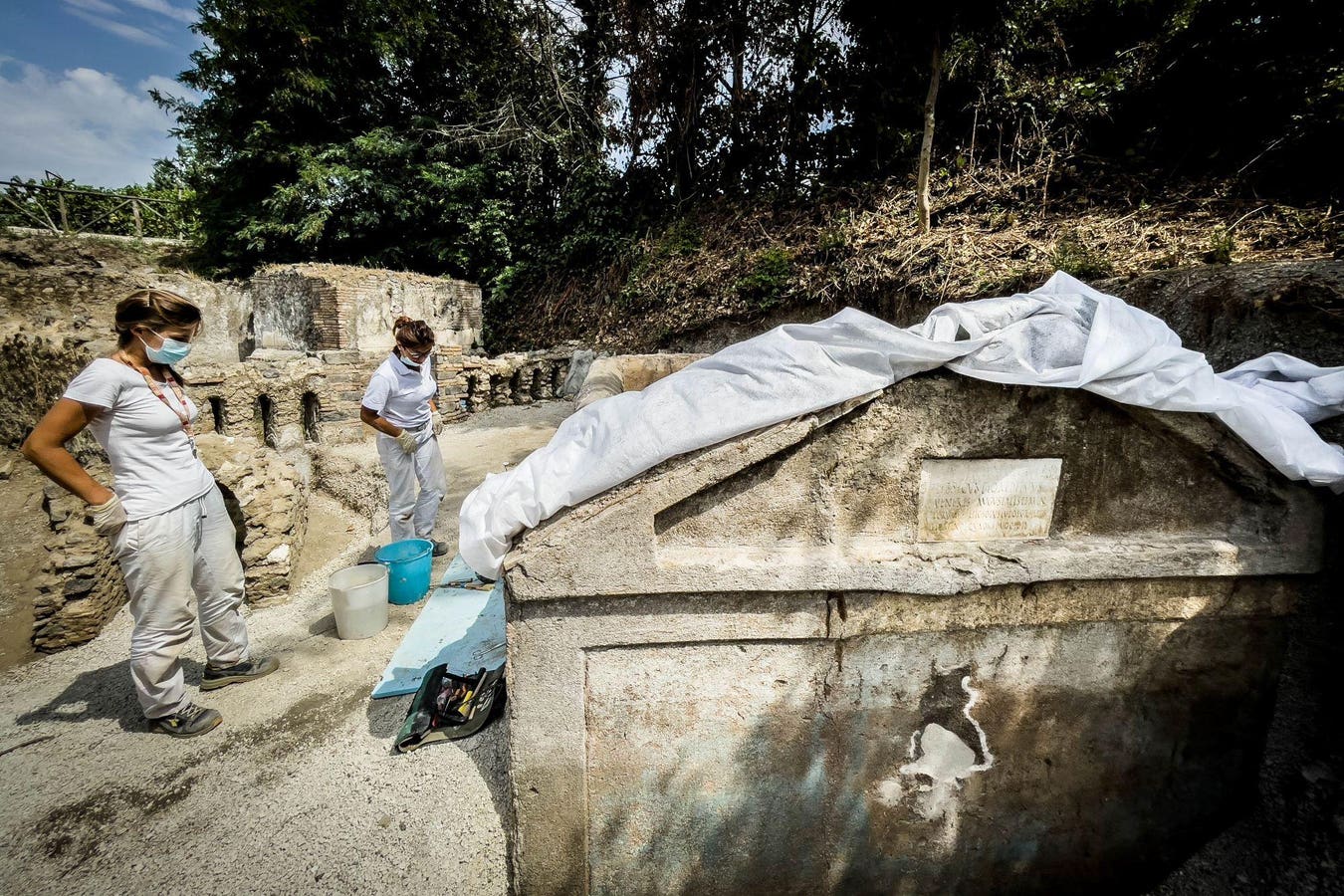
 
This is the description straight from the article. "Still more compelling is the reference to Greek culture in the tomb inscription. The epigraph states that Marcus Venerius Secundio “gave Greek and Latin ludi for the duration of four days”. Ludi graeci were theater performances in Greek language. “It is the first clear evidence of performances at Pompeii in the Greek language, which had previously been hypothesised on the basis of indirect indicators,” says the Director of the Archaeological Park of Pompeii, Gabriel Zuchtriegel."

That is an extraordinary discovery because it implies that, if plays were performed in Greek, there must have been a Greek-speaking population for an audience. Since we have no Pompeian literature, scholars have usually assumed that Pompeii was a Roman (resort) city and that, for instance, the innumerable paintings in the city (often on Greek subjects) were not created by local Greeks and were copies of works in Hellas. They even forgot the nearby Oracle of KymE [Cumae in Latin] and the comic Atellan Plays in the same Campanian region, not to mention the books in Greek by Parmenides and the other Eleatic philosophers.
 
Last edited:
  • Like
Reactions: cf_fraiser
That is an extraordinary discovery because it implies that, if plays were performed in Greek, there must have been a Greek-speaking population for an audience. Since we have no Pompeian literature, scholars have usually assumed that Pompeii was a Roman (resort) city and that, for instance, the innumerable paintings in the city (often on Greek subjects) were not created by local Greeks and were copies of works in Hellas. They even forgot the nearby Oracle of KymE [Cumae in Latin] and the comic Atellan Plays in the same Campanian region, not to mention the books in Greek by Parmenides and the other Eleatic philosophers.
Thanks for the additional context
 
That is an extraordinary discovery because it implies that, if plays were performed in Greek, there must have been a Greek-speaking population for an audience. Since we have no Pompeian literature, scholars have usually assumed that Pompeii was a Roman (resort) city and that, for instance, the innumerable paintings in the city (often on Greek subjects) were not created by local Greeks and were copies of works in Hellas. They even forgot the nearby Oracle of KymE [Cumae in Latin] and the comic Atellan Plays in the same Campanian region, not to mention the books in Greek by Parmenides and the other Eleatic philosophers.
Not a Reply but an Addition to the things scholars have constantly forgotten: Pompeiians had books written in Greek. This is not hearsay, because, through delicate modern techniques, Italians have reconstructed a book (by Epicurus, 3rd century B.C.) by analyzing the charred pages due to the volcanic eruption of 79 A.D. Most of the works written by this hedonistic philosopher from Samos have been lost who advocated Ataraxia [tranquillity; ...] as the good of life.
 
  • Like
Reactions: efhernandez_
Not a Reply but an Addition to the things scholars have constantly forgotten: Pompeiians had books written in Greek. This is not hearsay, because, through delicate modern techniques, Italians have reconstructed a book (by Epicurus, 3rd century B.C.) by analyzing the charred pages due to the volcanic eruption of 79 A.D. Most of the works written by this hedonistic philosopher from Samos have been lost who advocated Ataraxia [tranquillity; ...] as the good of life.
So cool to see how we were all connected back then without technology, thanks for sharing
 
  • Like
Reactions: amygdalE
This is an amazing discovery. I read somewhere that Pompeii in its early days was part of Magna Graecia (part of Ancient Greece) but then switched over to Roman control...
 
This is an amazing discovery. I read somewhere that Pompeii in its early days was part of Magna Graecia (part of Ancient Greece) but then switched over to Roman control...
In the 8th century B.C., various Greek trading posts [for pottery etc.] were etablished in southern Italy`. There followed Greek settlements [colonization] and founding of new cities... On a critical occasion, Pericles sent various Greeks to repopulate a city [Thourioi]; the sophist Protagoras and Herodotus were amongst them. Thourioi was attacked by Hannibal, but refugees founded what happens to be my native town. The hellenization was so vast that the Romans called southern Italy "Magna Graecia", which included Pompeii [near Naples/Neapolis and KymE]. For the sake of expansion in the Mediterranean, the Romans took administrative control of Magna Graecia, where they built roads to port-cities and their language became predominant. Pompeii and the island of Capri became Roman resort places, whereas the Sicilian Syracuse (the homeland of the great Archimedes) was conquered militarily. The Romans chased the vandalizing Hannibal off Italy and drove Pyrrhus of Epirus off Magna Graecia, but did not stop the invading Longobards, so that eventually my native town became an "oppidum Longobardorum" [town/fief of the Longobards] and lost its former freedom. Some toponyms and a bunch of words is what is left of its Greek culture. I have analysed the words of my native language: they are Greek and, at least in origin, Latin, and Italian (including some Italianized Longobardic words).
 
  • Like
Reactions: efhernandez_
In the 8th century B.C., various Greek trading posts [for pottery etc.] were etablished in southern Italy`. There followed Greek settlements [colonization] and founding of new cities... On a critical occasion, Pericles sent various Greeks to repopulate a city [Thourioi]; the sophist Protagoras and Herodotus were amongst them. Thourioi was attacked by Hannibal, but refugees founded what happens to be my native town. The hellenization was so vast that the Romans called southern Italy "Magna Graecia", which included Pompeii [near Naples/Neapolis and KymE]. For the sake of expansion in the Mediterranean, the Romans took administrative control of Magna Graecia, where they built roads to port-cities and their language became predominant. Pompeii and the island of Capri became Roman resort places, whereas the Sicilian Syracuse (the homeland of the great Archimedes) was conquered militarily. The Romans chased the vandalizing Hannibal off Italy and drove Pyrrhus of Epirus off Magna Graecia, but did not stop the invading Longobards, so that eventually my native town became an "oppidum Longobardorum" [town/fief of the Longobards] and lost its former freedom. Some toponyms and a bunch of words is what is left of its Greek culture. I have analysed the words of my native language: they are Greek and, at least in origin, Latin, and Italian (including some Italianized Longobardic words).
I love the Roman Empire, one of my favourites for sure. Thanks for sharing
 

Learning About Ancient Corinth

I’m hoping to visit the ruins of Ancient Corinth on a future trip to Greece, and I’d like to learn more about the history before I go. I always find that I appreciate archaeological sites more when I understand what I’m looking at and know some of the stories behind the ruins.

For those who have visited Ancient Corinth, what would you recommend learning about beforehand? Are there particular periods of the city’s history, important events, or historical figures that help put the site into context? I know Corinth had an important location and a long history, but I’d like to understand more about how the city developed and changed over time.

I’d also love recommendations for books, documentaries, podcasts, or other resources that give a good introduction to Ancient Corinth. What helped you understand the site and its history before or after your visit?

Why does the Battle of Thermopylae still capture so much attention?

The Battle of Thermopylae is one of those moments in Greek history that still seems to capture people's attention thousands of years later. The story of Leonidas and the small Greek force standing against the much larger Persian army has become a symbol of courage, sacrifice, and resistance against overwhelming odds.

Of course, the real history is more complicated than the legend, and Thermopylae was only one part of the larger Greco-Persian Wars. Still, there is something powerful about the idea of people choosing to hold their ground even when they know the outcome may not be in their favor.

I also think modern books, movies, and popular culture have helped keep the story alive, sometimes blending history with mythology. Why do you think the Battle of Thermopylae still fascinates people so much? Is it the history itself, the symbolism, or the legend that grew around it?

Fall of the City States (Polis)

I’ve been reading more about ancient Greek history lately, and something struck me — we always hear about the rise of the polis and how important city-states like Athens and Sparta were, but I don’t see as much discussion about how that system actually declined.

What led to the fall of the polis as the dominant structure in Greek life? Was it mainly due to constant warfare like the Peloponnesian War, or did larger powers like Macedon gradually make the independent city-state model obsolete?

I’m especially curious about whether this was a sudden shift or more of a slow transition over time. Did people living through it even realize the polis era was ending?

I’d love to gather more insight on this. Greek history is a big interest of mine, and this feels like an important piece I haven’t fully understood yet.

Themistocles: Hero, Politician, or Master Strategist?

This weekend I met someone named Themistocles, which immediately caught my attention. We ended up having a conversation about the famous Athenian statesman and general, and it got me thinking more about his place in Greek history.

Themistocles is often credited with recognizing the importance of naval power and helping secure the Greek victory at the Battle of Salamis. Without his foresight and strategy, the Persian Wars may have had a very different outcome. At the same time, he was also a politician who made powerful enemies and was eventually ostracized from Athens.

It made me wonder how people today view him. Was he primarily a hero who helped save Greece, a brilliant politician navigating a difficult era, or one of history's greatest military strategists? I'd love to hear your thoughts on his legacy and whether you think he gets the recognition he deserves.

Information about the Battle of Marathon

I'm planning a trip to Greece later this year, and one of the places I'm really hoping to visit is the site of the Battle of Marathon. I've read the basic history and know it was one of the most important battles of the Persian Wars, but I'd love to learn more before I actually stand where it happened.

For those of you who have visited Marathon or have studied this period of Greek history, what details or stories do you think are especially worth knowing? Are there any books, documentaries, or articles you'd recommend beforehand? Is there anything at the site that many visitors overlook or don't fully appreciate without some background?

I'd really like to understand not just the battle itself, but why it became such a defining moment in Greek history. Thanks in advance for any suggestions!
Share and discuss Greek history!

WorldwideGreeks.com is a free online forum community where people can discuss Greek food, travel, traditions, history and mythology.
Join Worldwide Greeks here!

JOIN COMMUNITY FOR FREE

LOGIN TO YOUR ACCOUNT
Back
Top

